
How to Choose a Cold Storage Thermostat: A Practical Buyer's Guide
A practical guide to selecting a digital thermostat for cold storage and refrigeration — covering temperature range, sensor type, defrost control, fan logic and how to match a controller to your room.
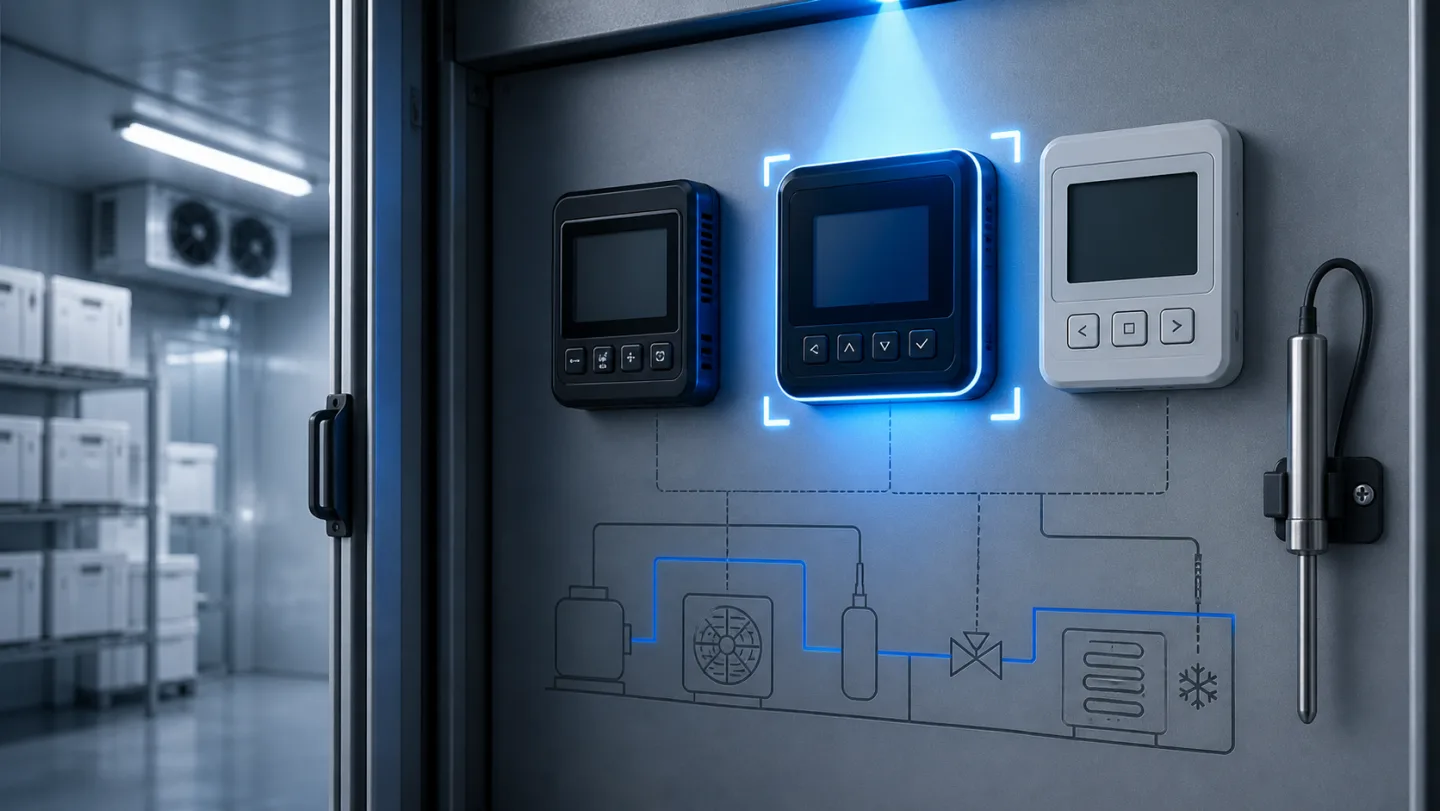
Choosing the right thermostat for a cold storage room is one of those decisions that looks simple until you are standing in front of a wall of options. Pick the wrong controller and you end up with temperature swings, iced-over evaporators, short-cycling compressors and product that does not keep. This guide walks through the factors that actually matter when you specify a digital thermostat for refrigeration and cold storage.
Start with the temperature range you need to hold
The first question is what temperature band the room has to maintain. A chiller holding fresh produce at 0 °C to 4 °C has very different requirements from a freezer running at −18 °C or a blast room pushing well below that. A good temperature controller should comfortably cover the full range you operate in, with measurement resolution of at least 0.1 °C so you are not blind to the small drifts that spoil sensitive goods.
Look closely at the control accuracy, not just the display resolution. A thermostat that reads to 0.1 °C but only switches on a 2 °C deadband will let the room wander far more than the display suggests. For tight cold-chain work, you want a controller whose differential (the gap between cut-out and cut-in) can be set small without short-cycling the compressor.
Match the sensor to the environment
Most refrigeration thermostats use NTC temperature sensors, and the probe matters as much as the controller. For cold storage you generally want:
- A waterproof, food-grade probe that survives wash-downs and condensation
- A cable long enough to reach the measurement point without splices
- A sensor rated for the low end of your temperature range, so it stays accurate at −30 °C and below
Many controllers support a second probe. That second input is what unlocks proper defrost termination and evaporator monitoring, which we cover next.
Defrost control is where cheap thermostats fall down
Any freezer running below 0 °C will ice up the evaporator coil over time, and that ice gradually strangles airflow and efficiency. The way a thermostat manages defrost is often the single biggest difference between a basic unit and a real refrigeration controller.
Look for these defrost features:
- Timed and temperature-terminated defrost — defrost ends when the coil sensor reaches a set temperature, not just when a timer expires, so you do not waste energy or leave ice behind
- Adjustable defrost interval and duration to match how fast your room actually frosts up
- Drip-off / drain delay after defrost, so melt water clears before the fans restart
- Electric or hot-gas defrost modes depending on your system
A controller with a dedicated evaporator probe can terminate defrost intelligently, which keeps the coil clean while avoiding the temperature spikes that come from over-defrosting.
Fan and compressor logic protect your equipment
Beyond simply switching the compressor, a capable thermostat coordinates the evaporator fans and protects the compressor from damage. The features worth checking:
- Compressor protection delays — minimum off-time and minimum on-time to prevent rapid short-cycling that burns out compressors
- Fan control modes — fans that pause during defrost and resume only when the coil is cold again, so you do not blow warm, humid air over the product
- Alarm outputs for high/low temperature, sensor failure and door-open events
These protections are not luxuries. Short-cycling alone is one of the most common causes of premature compressor failure in small and mid-sized cold rooms.
Installation, wiring and panel fit
A controller has to fit the cabinet and the people who maintain it. Confirm the panel cut-out size (35 mm × 77 mm is a common refrigeration standard), the supply voltage (many units accept both 220 V AC and 12/24 V variants), and the relay ratings for compressor, defrost and fan outputs so they match your contactors and loads.
Clear front-panel programming, a lockable keypad to stop unauthorised changes, and a readable display in a cold, dim room all make day-to-day operation far easier.
Connectivity: do you need remote monitoring?
Networked thermostats with WiFi or Bluetooth let you log temperature history, receive alarms remotely and prove cold-chain compliance without someone walking the room with a clipboard. If you manage multiple rooms or need audit records for food safety, that data trail is worth the small premium. If you run a single simple room, a robust standalone controller may be all you need.
A quick selection checklist
Before you commit, run through these questions:
- Does the temperature range and accuracy cover my coldest and most sensitive load?
- Does it support a second probe for proper defrost termination?
- Are the defrost interval, duration and termination all adjustable?
- Does it have compressor protection delays and sensible fan logic?
- Do the relay ratings and panel cut-out match my hardware?
- Do I need remote monitoring and alarm logging for compliance?
If you can answer those, you can specify a controller with confidence. Beamform's digital thermostats are built specifically for refrigeration and cold storage, with dual-probe defrost control, compressor protection and configurable fan logic. To see how the BF-6800 series maps onto the checklist above, browse our full product range or get in touch for help matching a controller to your room.