
Electric vs. Hot-Gas Defrost: Which Is Right for Your Cold Room?
A clear comparison of defrost methods in refrigeration — natural, electric and hot-gas defrost — covering energy use, defrost time, cost and how your temperature controller manages each.
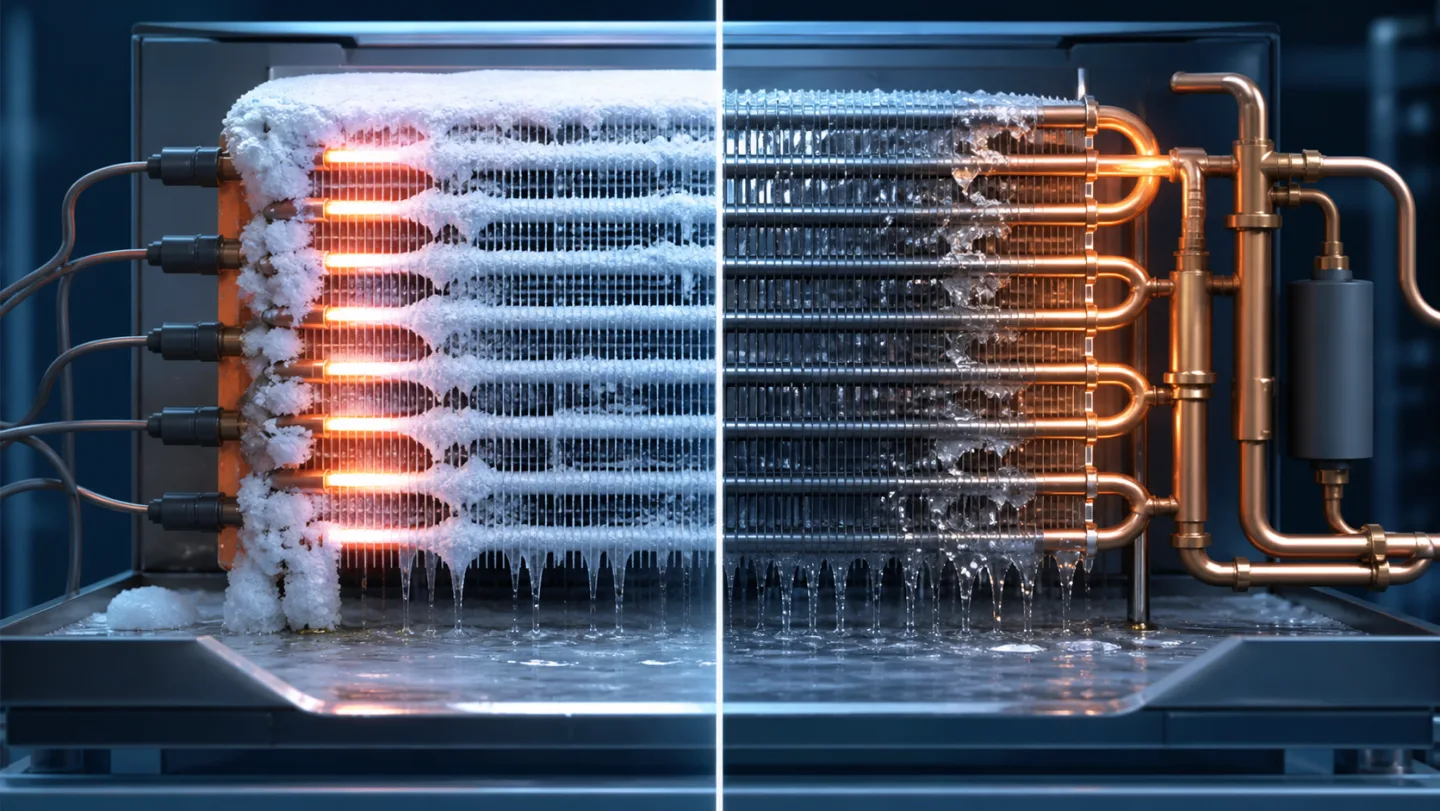
Frost on the evaporator coil is unavoidable in any refrigeration system running below freezing. The question is not whether to defrost, but how. The defrost method you choose affects energy consumption, how fast the room recovers, and how hard your temperature controller has to work. Here is how the three common approaches compare.
Natural (off-cycle) defrost
For coolers that stay above roughly 2 °C, the simplest method is natural defrost: the compressor stops periodically and the coil thaws using the warmth of the room air alone. There is no heater and no added energy, so it is cheap and reliable — but it only works when the room temperature is high enough to melt ice on its own. For anything running near or below freezing, it is too slow.
Electric defrost
Electric defrost uses heating elements built into or wrapped around the evaporator coil. When defrost starts, the compressor and fans stop, the heaters energise, and the ice melts. It is the most common method for freezer rooms because it is straightforward to install and the controller logic is simple.
The cost is energy: you are adding heat to a space you are trying to keep cold, so every defrost cycle is paid for twice — once to run the heater, once to pull that heat back out. Good temperature control limits the damage by terminating defrost on coil temperature rather than a fixed timer, so the heaters switch off the moment the ice is gone.
Hot-gas defrost
Hot-gas defrost reroutes hot refrigerant discharge gas back through the evaporator, melting ice from the inside of the coil. It is fast and energy-efficient — the heat comes from the system itself rather than an external element — which makes it attractive for large installations with many coils. The trade-off is plumbing and control complexity, so it is usually reserved for bigger industrial systems.
How the controller ties it together
Whichever method you use, the temperature controller is what makes defrost efficient:
- Termination on coil temperature ends defrost as soon as the coil is clear, instead of running a fixed time and overheating the room
- Adjustable interval lets you defrost only as often as the room actually frosts up
- Drain / drip-off delay holds the fans off until melt water clears
- Fan delay on restart keeps the fans off until the coil is cold again, so you do not blow warm humid air over the product
A controller that handles all of this — like the BF-6800 series with its dual-probe defrost logic — lets you pick the defrost method that fits your room without giving up efficiency. Browse the full range or contact us to talk through your setup.