
Temperature and Humidity Control for Greenhouses: What the Controller Actually Needs to Do
A practical guide to temperature and humidity control systems for commercial greenhouses and agricultural buildings — covering multi-zone management, CO₂ integration, alarm logic, and remote monitoring.
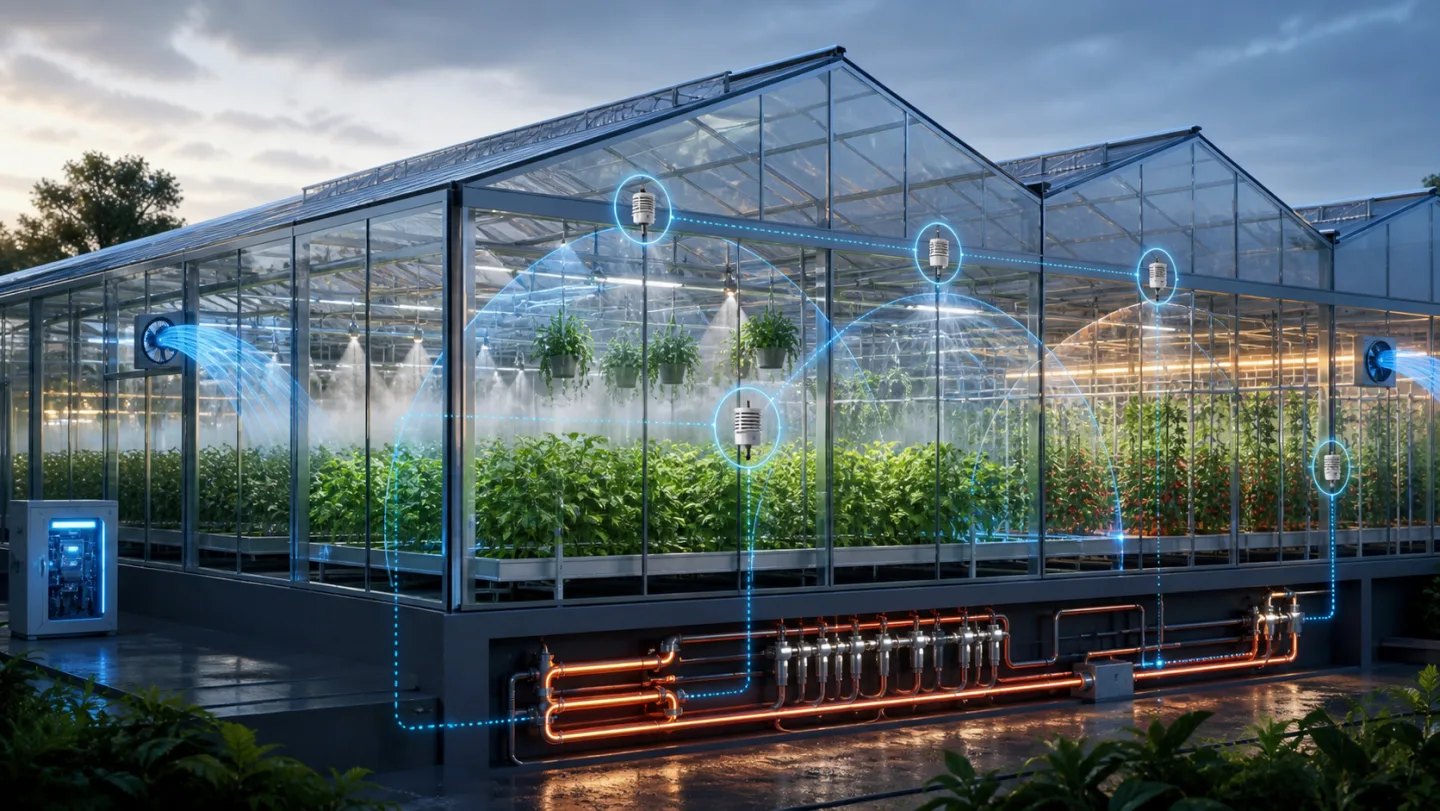
Greenhouse climate control looks simple from the outside — keep it warm, keep it humid, let the plants grow. The reality is that a commercial greenhouse running high-value crops has more in common with a pharmaceutical manufacturing environment than a domestic polytunnel. This guide covers what a temperature and humidity control system actually needs to do in an agricultural building, and where basic thermostats fall short.
Why greenhouses are harder to control than cold rooms
A cold storage room has one goal: hold a set temperature. A greenhouse has to balance temperature, humidity, CO₂ concentration, ventilation, and heating — often across multiple distinct zones — with conditions changing continuously as light levels, outside temperature, and crop transpiration shift throughout the day.
Add to that the specific vulnerabilities of agricultural environments: high humidity corrodes cheap electronics, wide temperature swings stress sensors, and a control failure at the wrong time in the growing season is not a recoverable situation.
Temperature control: the basics
The temperature loop in a greenhouse is typically more complex than a single-setpoint thermostat. What a capable agricultural controller should handle:
Multi-setpoint scheduling — day and night setpoints differ, often by 5–10 °C, and the transition schedule may follow sunrise/sunset rather than a fixed clock. Plants grown on a DIF programme need the temperature to drop sharply before dawn and rise after sunrise, which requires the controller to drive both heating and ventilation on a tight schedule.
Heating and cooling integration — the controller needs to coordinate tube heating, underfloor heating, HAF fans, and roof vents as separate actuators that are partially in opposition. A thermostat that only switches one relay cannot do this.
Zone separation — propagation bays, fruiting areas, and finished-plant staging areas often have different temperature requirements. A single controller covering the whole house is usually the wrong answer for anything beyond the smallest nursery.
Humidity: the hidden variable
Relative humidity in a greenhouse has to stay within a band: too low and transpiration stress limits growth; too high and Botrytis and other fungal diseases take hold. The difficulty is that humidity in a greenhouse is highly dynamic — it spikes when heating is off overnight and drops when vents open in the morning.
A temperature-only controller gives you no visibility of humidity at all. The right approach is a combined temperature and humidity controller — such as the BF-6920 with an optional humidity probe — that can trigger ventilation, heating, or fogging based on RH setpoints as well as temperature, and log both values for crop records.
Useful humidity control logic:
- Minimum pipe heating to prevent condensation overnight, even when room temperature is at setpoint
- Automatic vent cracking to purge humid air before humidity alarms fire
- Fog/mist trigger with a humidity upper limit to avoid over-humidifying
CO₂ and light: extending beyond temperature
In high-value commercial greenhouse production, CO₂ enrichment is normal practice. The CO₂ controller needs to interlock with the ventilation controller — there is no point enriching when vents are open. That interlock is software logic: the CO₂ dosing valve should only open when the ventilation controller confirms vents are closed.
A custom-firmware temperature controller with analog inputs for CO₂ and PAR light sensors, Modbus outputs to a CO₂ dosing valve controller, and interlock logic written into the control algorithm can handle this as a single coordinated system — instead of separate single-purpose units that do not communicate.
Alarm logic for agricultural buildings
Agricultural alarm logic is different from food-storage alarm logic. In a greenhouse:
- A frost alarm (temperature below 2 °C) needs an immediate response — heating failure in winter can kill an entire crop overnight
- A high temperature alarm (roof vents stuck closed in summer) is equally urgent but in the opposite direction
- A power failure alarm is critical because most heating and ventilation is electrically driven
- Remote notification by SMS, push notification, or email is often mandatory in a professional operation — there is no 24-hour on-site team in most nurseries
Controllers with 4G connectivity handle remote alarming without depending on the building's internet connection, which is unreliable in rural locations.
Multi-zone architecture: how to wire it properly
For a greenhouse with multiple zones, the typical architecture is:
- One master controller or HMI panel that displays all zones, handles scheduling, and logs data
- One zone controller per heating/ventilation circuit, wired over RS-485 Modbus to the master
- Sensor nodes placed at canopy height (where crop temperature matters) rather than at the controller
The master controller — ideally a color touchscreen panel — shows all zone temperatures and humidity readings simultaneously, flags alarms, and stores the trend data needed for crop management decisions and audits.
Remote monitoring for remote sites
Many agricultural buildings are staffed intermittently or not at all overnight. A controller with 4G connectivity and cloud-based logging means an agronomist can check all greenhouse zones from a phone at 2 AM without driving to site. Alarm push notifications mean the first sign of a control problem reaches the right person within minutes.
Custom-firmware controllers with MQTT over 4G can feed data directly into agricultural management software, eliminating manual temperature logs and enabling better crop-cycle analysis.
What to specify
When you are specifying a greenhouse control system, ask for:
- Combined temperature and humidity control on one device
- Multi-setpoint day/night scheduling built into the firmware
- Multiple relay outputs for heating, ventilation, and fogging
- RS-485 Modbus for multi-zone integration
- 4G or WiFi for remote monitoring and alarm push
- Color touchscreen HMI if you are managing more than two zones
- Sensor inputs rated for high-humidity environments
For custom agricultural control systems — from small nurseries to large multi-tunnel operations — contact Beamform to discuss a controller specification that fits your crop, your building, and your monitoring requirements.