
Temperature Logging for Food Safety Compliance: What Your HACCP Records Actually Need
A practical guide to temperature logging requirements for HACCP, BRC, and food safety compliance — what records you need, how long to keep them, and how automated logging compares to manual checks.
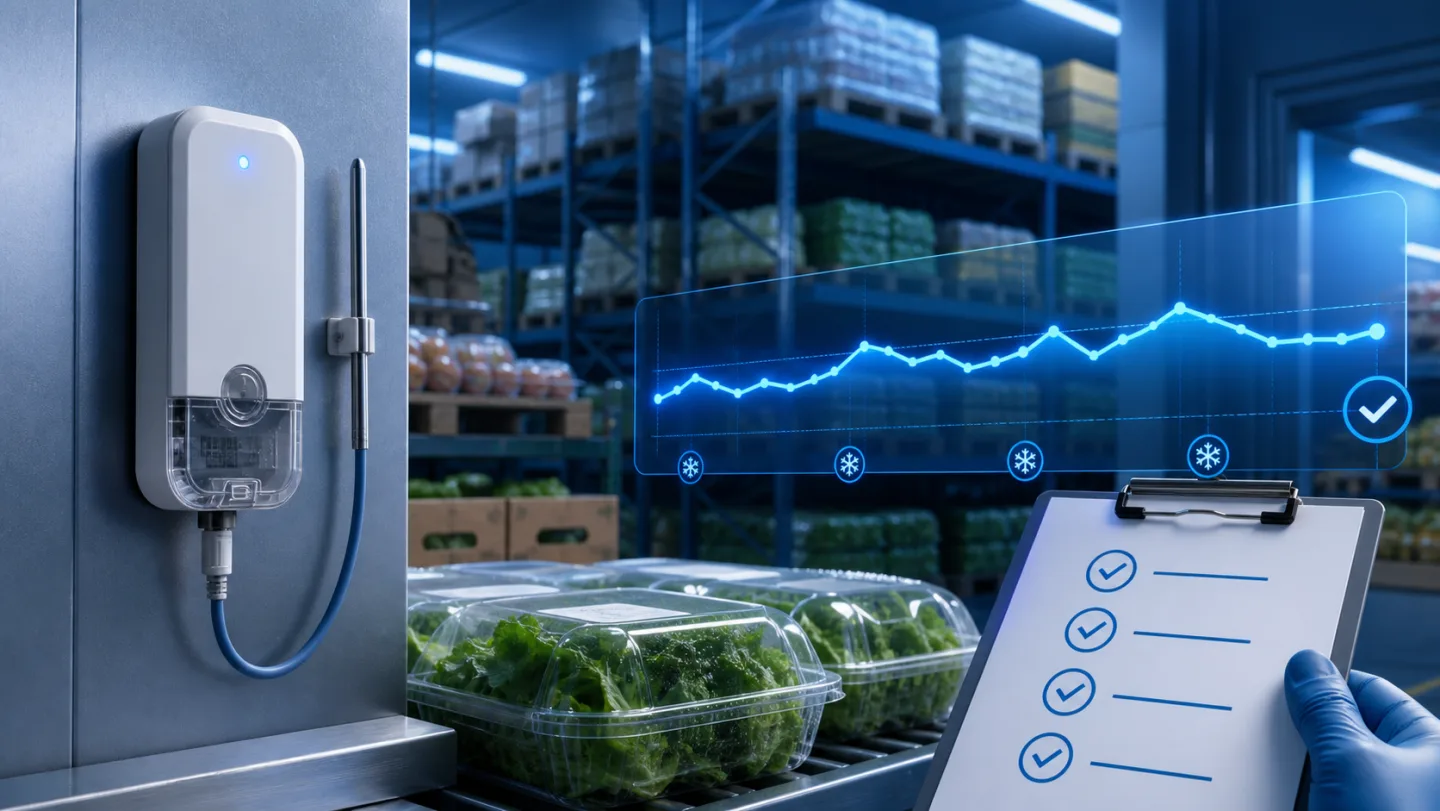
Food businesses face increasing scrutiny over cold-chain temperature management, and the documentation requirements have quietly become more demanding than many operators realise. Manual temperature checks — someone with a probe thermometer and a clipboard, twice a day — satisfied auditors a decade ago. Today, most food safety standards either require or strongly favour continuous automated logging. This article explains what the records actually need to show and why the method of recording matters as much as the data itself.
What HACCP temperature monitoring requires
HACCP (Hazard Analysis and Critical Control Points) is a framework, not a fixed set of rules. The actual monitoring requirements are set by the specific HACCP plan developed for each food business, which identifies Critical Control Points (CCPs) and defines:
- The critical limit at each CCP (e.g., maximum storage temperature)
- The monitoring procedure — what is measured, how often, by whom
- The corrective action when a limit is breached
- The verification that monitoring is working correctly
- The records that document all of the above
For cold storage, the CCP is typically the storage temperature of a high-risk product. The critical limit is a maximum temperature (e.g., ≤ 5 °C for chilled, ≤ −18 °C for frozen). The monitoring procedure must be capable of detecting an excursion before product is affected — which means the monitoring frequency has to reflect how quickly the product could reach an unsafe temperature if the refrigeration failed.
Continuous logging versus manual checks
This is where most HACCP plans are underspecified. A manual check twice a day detects a temperature problem at most 12 hours after it started. In a chilled store running at 4 °C, a compressor failure at midnight will not be discovered until the morning check — by which time product has been above temperature for 8–10 hours.
Continuous electronic logging — 5-minute or 10-minute intervals — detects the same failure within minutes of the alarm threshold being crossed and records the exact time and duration of the excursion. The difference in product exposure is not small; it is the difference between a disposable batch and an investigated incident.
Most food safety auditors (BRC, IFS, FSSC 22000) will accept manual checks in low-risk applications but expect continuous electronic monitoring for any high-risk cold storage. The BRC Global Standard for Food Safety explicitly states that electronic monitoring systems should be used where practicable for CCPs.
What the records need to show
Temperature records for food safety purposes need to demonstrate:
Continuous coverage — records should show that monitoring was continuous (or at a defined interval) with no unexplained gaps. A log that shows readings at 8 AM and 5 PM every day but nothing in between does not demonstrate that the cold room stayed in range overnight.
Calibration traceability — the temperature probe used for records must be calibrated and the calibration documentation must be traceable to a national standard. For electronic logging systems, annual recalibration of the temperature probe (not just the controller) is the minimum expected standard.
Alarm events and corrective actions — every temperature excursion should appear in the records as a discrete event with start time, peak temperature, duration, and the corrective action taken. A system that simply overwrites logged data without flagging excursions is not acceptable to most auditors.
Tamper-evident records — paper logs can be altered; electronic records can be edited. Auditors are increasingly looking for electronic logging systems that produce read-only records with an audit trail — if a record has been modified, the modification should be visible.
Retention — most food safety standards require temperature records to be kept for a minimum period, typically the shelf life of the product plus one year, or 12 months as a minimum regardless of product type. Some pharmaceutical cold-chain applications require five years.
Automated logging in practice
An automated temperature logging system connected to a cold room controller needs to handle a few things that are easy to overlook:
Alarm notification — the value of a logging system is zero if nobody is notified when temperature goes out of range. Define the alarm threshold (typically 2–3 °C below the critical limit, so there is time to respond before the CCP is breached), set an appropriate delay (to avoid false alarms from door openings), and confirm that alerts reach a person who can act out of hours.
Probe placement — the logging probe should represent product temperature, not air temperature at the return duct. For compliance purposes, the probe position should be documented and consistent — if someone moves the probe, the records are no longer comparable to previous periods.
Power failure resilience — a logging gap during a power outage is a compliance problem. The controller or logger should have battery backup sufficient to maintain logging and alarm output for at least 30 minutes, and the power outage itself should be a logged event.
Report format — the ability to generate a PDF or CSV report covering a defined period (a day, a week, a month) is a practical necessity. Auditors do not want to scroll through raw time-series data on a controller screen; a formatted report showing all readings, alarm events, and calibration status saves significant time during audits.
What changes if you are in a regulated industry
For pharmaceutical cold storage (GDP/GMP), blood banks, and medical laboratories, the requirements go beyond food-safety HACCP. Key differences:
- Mapping studies — before a pharmaceutical cold room goes live, a temperature distribution study (mapping) must demonstrate that the room holds the required temperature at every point, not just at the sensor. Mapping must be repeated after significant maintenance or structural changes.
- 21 CFR Part 11 / Annex 11 compliance — electronic records in pharmaceutical applications must meet audit trail, access control, and data integrity requirements set out in 21 CFR Part 11 (US) or EU GMP Annex 11. This typically requires electronic signatures for parameter changes and a system that prevents record deletion.
- Calibration frequency — pharmaceutical cold storage usually requires more frequent probe calibration (every 6 months in many SOPs vs. annually for food applications).
For medical and pharmaceutical applications, a custom-firmware controller with access control, audit log, and structured data export is typically the right approach rather than a standard thermostat with a bolt-on logger.
A practical audit preparation checklist
Before your next food safety audit, verify that your temperature monitoring system can produce:
- A continuous temperature record for the past 30 days (or required retention period) with no unexplained gaps
- A list of all alarm events in that period, with timestamps and corrective actions documented
- Calibration certificates for all probes, dated within the required calibration interval
- Evidence that alarm notifications were tested and are reaching a named, contactable person
- Documentation of probe placement (photo, description, date last verified)
- A record of any setpoint changes made during the period
Beamform's temperature controllers — including the BF-6800 series with 4G/WiFi connectivity — support continuous logging, alarm notification, and data export for food safety compliance. For bespoke compliance logging requirements or pharmaceutical-grade solutions, contact the Beamform team.