
OEM Temperature Controller Packaging: A Private-Label Release Checklist
Specify private-label temperature controller artwork, labels, manuals, identifiers, accessories, cartons, transit tests, and approval records before production release.
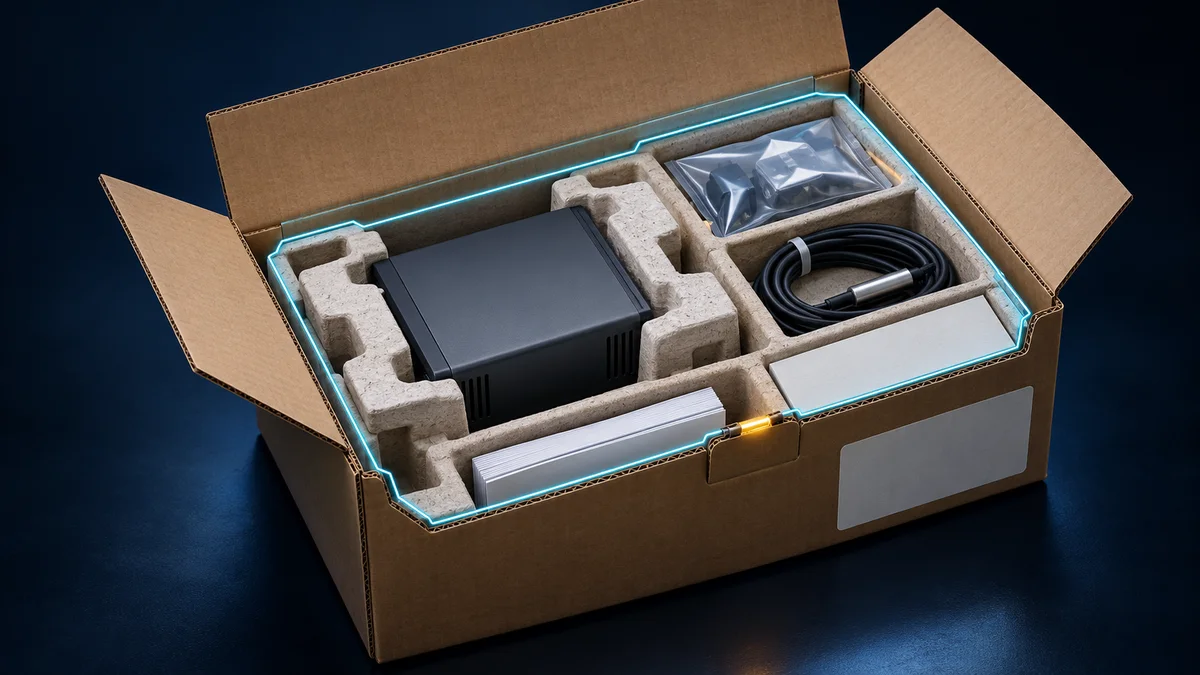
OEM temperature controller packaging is not the last decorative step before shipment. In a private-label program, the product marking, instructions, accessories, inner pack, transport carton, identifiers, and approved product configuration must all describe the same item.
A correct controller in the wrong box—or the right box with an obsolete manual or label—can create receiving, installation, traceability, and market-access problems. This guide gives procurement and engineering teams a release framework. It does not assume that any marking, barcode system, test procedure, certificate, packaging material, or commercial term is included in a standard quotation.
Start with a sellable-unit and pack hierarchy
Define every level before artwork begins:
- Product unit — controller, applied product label, firmware and parameter identity.
- Sellable or service pack — controller plus the agreed sensor, harness, fasteners, instructions, and other accessories.
- Inner or master carton — quantity per carton, dividers, cushioning, orientation, closure, and carton identification.
- Logistics unit — pallet or other shipment configuration, shipping label, and destination-specific documentation.
Give each approved combination a buyer part number and a supplier project or configuration identifier. If two products look similar but use different firmware, sensors, supply arrangements, languages, or accessories, do not rely on carton colour or a handwritten note to distinguish them.
This hierarchy should be part of the configuration baseline in the OEM production quality plan, not a purchasing note held outside engineering control.
Build a variant matrix before making labels
Create one row for every orderable configuration. Useful columns include:
- Buyer SKU and product name.
- Supplier model or project identifier.
- Hardware, firmware, parameter, HMI, language, and communication-map revisions.
- Power supply, sensor, cable, connector, relay or output variant, and included accessories.
- Product-label artwork revision and instruction revision.
- Unit-pack, inner-carton, and master-carton bill of materials.
- Sales region, required language set, and target-market review status.
- GTIN or other customer-owned identifier, if applicable.
- Effective purchase order, lot, serial range, or change cut-in point.
The matrix prevents one artwork file from being reused across configurations that are electrically or operationally different. It also gives the supplier a testable rule for matching programmed units to labels and packs.
Separate four kinds of identification
Do not force every purpose into one sticker. Treat these information layers separately, even if some are printed together.
Brand and commercial identity
Control the logo, product family name, colour references, typography, finish, placement, and permitted printing method. Supply vector artwork and a brand guide; screenshots and low-resolution images are not production masters.
Product and technical identity
Define the buyer model, supplier configuration reference where required, electrical and sensor fields, terminal identification, warnings, and other technical content needed for the actual product. The label must match the released hardware, firmware, documentation, and target market.
Traceability identity
Agree how a unit or lot links to production and test records: serial number, lot code, date code, firmware reference, or another controlled key. State who creates the number, how duplicates are prevented, where the record is stored, and what happens after rework or replacement.
Trade and logistics identity
GTINs, customer barcodes, carton labels, purchase-order data, and logistics-unit identifiers serve supply-chain processes. They should not be improvised by the factory. GS1's GTIN Management Standard provides rules for consistent trade-item identification and specifically addresses changes such as primary brand, package quantity, dimensions or gross weight, and adding or removing a certification mark. The brand owner or other designated party should allocate identifiers and approve the encoded data.
Treat market markings as controlled compliance content
A private-label buyer may become the manufacturer in a legal sense, depending on the market and how the product is placed on that market. For the EU, official guidance describes a manufacturer as the party that makes a product, or has it designed or made, and markets it under its own name or trademark. That party must identify applicable requirements, complete the appropriate conformity work, prepare required technical documentation, and provide applicable labels, traceability, instructions, and safety information (EU product-compliance guidance).
Therefore, an artwork brief should identify:
- Countries or regions where the product and host equipment will be sold.
- The responsible economic operators and compliance owner.
- Which markings are required, prohibited, or pending evidence.
- Exact technical fields, languages, minimum sizes, locations, and permanence criteria from the applicable requirements.
- The document or approval record that authorizes each conformity or certification mark.
Do not copy a CE, certification, recycling, or disposal symbol from a reference product. The European Commission notes that CE marking applies only where the relevant rules require it, and it is forbidden on products outside that scope (official CE marking overview). Release such marks only after the responsible party confirms the product, scope, evidence, and production-control conditions.
Make instructions part of the same release
The product label, terminal map, HMI, parameter table, quick-start sheet, and full manual must use the same names, units, warnings, and revision logic. IEC/IEEE 82079-1:2019 provides general principles and requirements for preparing and managing information for use across many product types; it does not decide which product-specific information your project requires.
For each language, define:
- Source-language owner, translator, reviewer, and technical approver.
- Terms that must match firmware screens and terminal names.
- Illustrations tied to a specific mechanical and electrical revision.
- How safety information and residual risks are reviewed.
- File format, print size, paper or digital delivery, and revision identifier.
- The rule for removing obsolete copies from packing stations.
A translation should not be released merely because it fits the page. Test critical steps with the intended product and have a qualified reviewer confirm the target language and technical meaning.
Define the pack-out bill of materials
The packaging specification should identify more than “one controller per box.” List every item, quantity, material or drawing reference, orientation, and acceptable alternative:
- Controller and protective films or caps.
- Temperature or humidity probes, harnesses, connectors, fasteners, mounting clips, and accessories.
- Printed or digital instructions and destination-specific documents.
- Bags, separators, end caps, cushioning, desiccant or corrosion protection only where the environment and material assessment require them.
- Unit carton, inner carton, master carton, closures, labels, and tamper features if specified.
- Maximum and minimum pack quantities, carton dimensions, and gross-weight acceptance method.
Add a visual pack-out standard showing the approved orientation and each cavity. The image should support the bill of materials, not replace it. Record allowed material substitutions and who may approve them.
Verify barcodes on the finished packaging
A barcode file that scans on a monitor is not proof that the printed pack will scan. Printing process, substrate, coating, curvature, contrast, quiet zones, size, placement, and later abrasion can change performance. GS1's barcode-quality guidance highlights check digits, quiet zones, contrast, construction, size, height, packaging interference, damage, and positioning as common checks.
Define:
- Symbology, encoded data, human-readable text, and data owner.
- Which packaging level receives which identifier.
- Print method, substrate, colour, size, location, and orientation.
- Verification method, acceptance grade where the applicable specification defines one, sampling plan, and retained report.
- Scan checks using representative receiving, warehouse, or point-of-sale equipment when relevant.
Approve the final printed production sample, not only a PDF proof. A normal scanner can confirm that data is readable in one setup; a verifier measures conformance to the relevant symbol specification.
Design transport verification around the real route
First document the distribution system: unit or master carton, parcel or pallet handling, route, transfers, stacking, storage duration, temperature and humidity exposure, and known shock or vibration risks. Then choose a test plan that represents the desired evidence.
ISTA explains that its procedures range from non-simulation screening tests to general and enhanced simulations, and that selecting the correct procedure depends on the intended outcome and distribution environment (ISTA test-procedure overview). A passed screening test should not be described as proof of every shipping route.
Where handling symbols are needed, ISO 780:2015 defines conventional graphical symbols for handling and storage of distribution packages. Its scope says the symbols should be used only when necessary and excludes dangerous-goods-specific instructions. Select symbols from actual handling needs rather than filling the carton with decorative marks.
After testing, inspect both package and product: carton and closure, cushioning movement, accessory contact, label and barcode damage, enclosure appearance, connector or sensor damage, and agreed functional checks. Record the exact product configuration, pack revision, loading pattern, test procedure and revision, deviations, results, and disposition.
Release a packaging first article
Before volume packing, build and approve a representative first article using production-intent materials and processes. The review should include:
- Scan the unit and carton identifiers and compare decoded data with the approved matrix.
- Confirm product, firmware, parameter, label, instructions, sensor, cable, and accessories match the SKU.
- Check artwork placement, colour reference, legibility, adhesion, abrasion resistance, and label permanence against the agreed methods.
- Perform the pack-out from a blank station instruction and record ambiguity or handling risk.
- Measure carton quantity, dimensions, and gross weight using the approved method.
- Verify closure, tamper feature where specified, pallet or shipment pattern, and logistics labels.
- Photograph the approved result and link it to controlled files rather than treating photographs as the master specification.
Later changes to firmware, product marking, instructions, accessories, carton quantities, identifiers, or packaging materials should enter the OEM controller change-control process. Define whether old and new packs may coexist, how stock is segregated, and which lot or order receives the change.
Beamform standard and project-evaluated scope
Beamform's published product pages describe standard controller platforms, including the BF-6800 / 6810 refrigeration controller and the BF-6920 / 6921 touchscreen platform. Their listed model functions and specifications are the starting configuration for those products.
Beamform's website separately presents silk-screen or sticker branding and retail or bulk packaging as customization capabilities. That does not make a buyer's logo, label content, barcode, manual, accessories, carton, test plan, or market marking a stock configuration. Each must be evaluated and released against the actual SKU matrix, target market, quantities, supplied artwork, identifier ownership, pack-out, verification evidence, and approval responsibilities.
Final feasibility, cost, MOQ, tooling, sample scope, compliance work, and schedule can be confirmed only after those inputs are reviewed. Use the OEM RFQ checklist, then contact Beamform with the packaging release package.
Buyer handoff checklist
- SKU and configuration matrix with revision and cut-in rules.
- Vector brand artwork and visual identity requirements.
- Product-label field matrix and terminal-identification files.
- Target markets, languages, responsible parties, and approved market markings.
- GTIN, barcode, serial, lot, and logistics-data ownership rules.
- Manual, quick-start, HMI, and firmware terminology alignment.
- Complete accessory and pack-out bill of materials.
- Unit, inner, master-carton, and logistics-unit drawings.
- Distribution environment and requested packaging evidence.
- Artwork, barcode, first-article, and change-approval contacts.
- Prototype, pilot, and forecast quantities for project evaluation.
Frequently asked questions
Can a supplier create the barcode for a private-label temperature controller?
The supplier can print an approved symbol, but the buyer should define who owns and allocates the identifier, which data it encodes, and which packaging level it identifies. Identifier ownership and artwork production are different responsibilities.
Is a scanned barcode automatically compliant?
No. A successful scan is useful but depends on that scanner and setup. Verification measures the printed symbol against the applicable specification and should also confirm data integrity, placement, and the intended scanning environment.
Should the controller and carton use the same serial number?
Only if the traceability design requires it. Define how unit identity, lot identity, carton contents, rework, split cartons, and replacements relate in the record system. Do not add serialisation without a process for uniqueness and data retention.
Which packaging test should an OEM buyer request?
There is no universal answer. Define the packaged-product size and weight, shipment configuration, distribution route, handling mode, hazards, and evidence objective first. Then select the applicable procedure and acceptance criteria with qualified packaging and logistics personnel.
When is private-label packaging ready for mass production?
After the parties approve the exact product configuration, artwork, identifiers, instructions, accessories, pack-out, production-intent first article, required verification evidence, and change-control rules—not when the carton design alone looks finished.
Sources
- GS1 — GTIN Management Standard
- GS1 — Barcode quality checks
- European Union — General product compliance and manufacturer responsibilities
- European Commission — CE marking overview
- IEC/IEEE 82079-1:2019 — Preparation of information for use
- ISTA — Test procedures and selection overview
- ISO 780:2015 — Graphical symbols for handling and storage of packages