
OEM Thermostat MOQ, Tooling Cost and Lead Time: What to Expect at Each Customization Tier
A breakdown of minimum order quantity, tooling investment, and lead time for OEM temperature controllers — from a firmware-only rebrand to a fully custom enclosure and PCB.
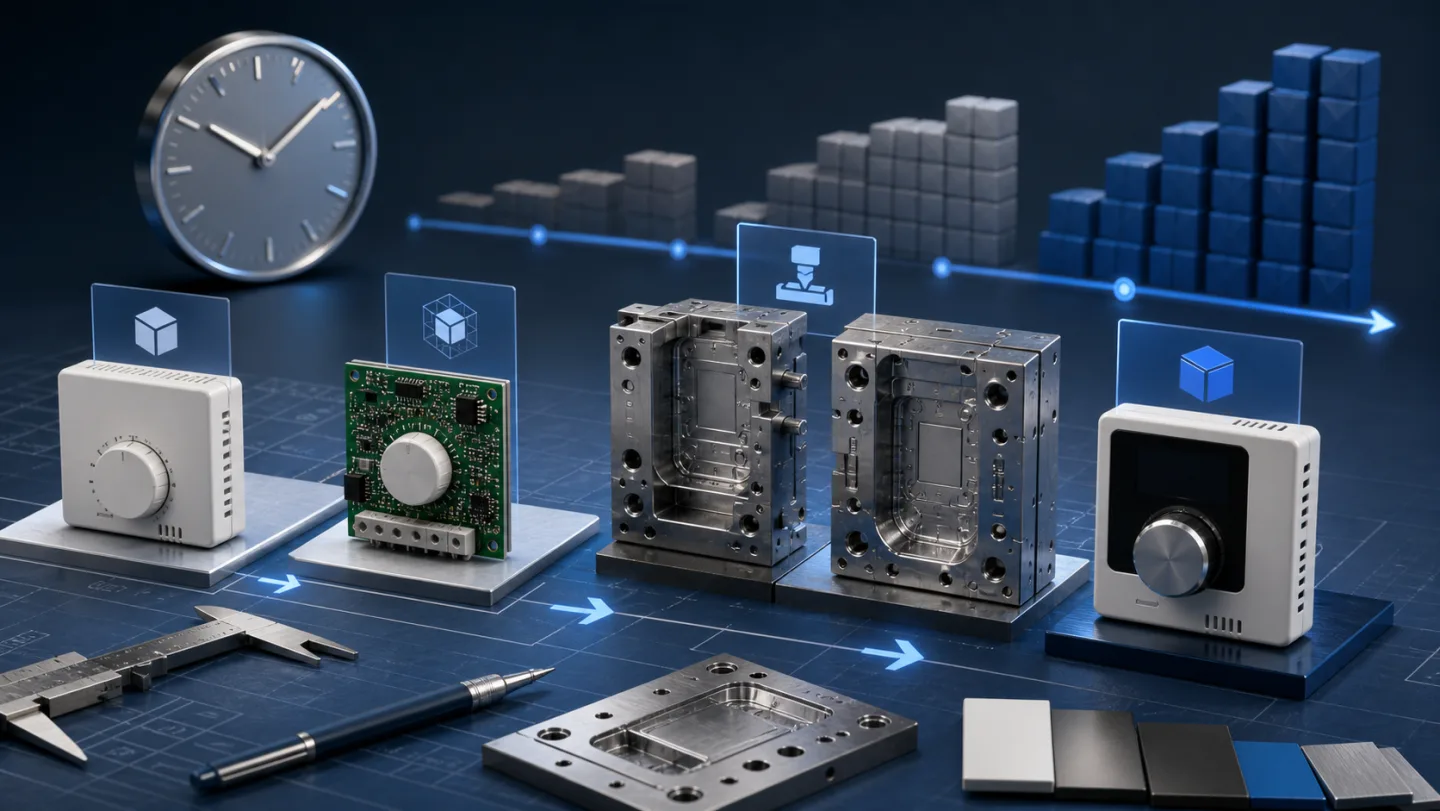
Minimum order quantity is usually the first question a buyer asks about OEM development, and it is also the most misunderstood — because MOQ is not one number. It depends entirely on how deep the customization goes. A firmware-only rebrand and a fully custom PCB with a new injection-molded enclosure sit at completely different investment tiers, with different MOQ, tooling cost, and lead time at each level. This article breaks down what to expect at each tier so you can plan a realistic first order.
Tier 1: Label and firmware parameter customization
The lightest tier changes the branding, packaging, and default operating parameters of an existing standard product — no hardware changes at all.
- What changes: your logo and packaging, factory-preset setpoint/differential/defrost defaults, display language, lock password
- Tooling cost: none — no new PCB, no new enclosure
- Typical MOQ: a few hundred units, sometimes lower for an established product line
- Lead time: often 2–4 weeks from confirmed artwork and parameter sheet to first shipment, since it rides on an existing production line
This tier suits buyers testing an OEM relationship for the first time, or private-labeling a proven controller without needing anything the standard version cannot already do internally.
Tier 2: Firmware logic and communication customization
This tier keeps the existing PCB and enclosure but modifies the firmware itself — control algorithm, register map, alarm logic, or added communication protocol.
- What changes: control logic (e.g. added PID mode, custom state machine), Modbus register map, MQTT topic structure, alarm and logging behavior
- Tooling cost: none for the physical build, but firmware engineering time is billed separately — typically a one-time NRE (non-recurring engineering) fee depending on scope
- Typical MOQ: often similar to Tier 1, sometimes moderately higher to offset the NRE investment against volume
- Lead time: 4–8 weeks, dominated by firmware development and validation against your actual application, not manufacturing
Most buyers integrating a controller into a larger system — a BMS, a SCADA platform, a cloud dashboard — land here, because the value is in the register map and protocol, not the physical hardware.
Tier 3: Hardware modification within an existing enclosure
This tier changes the PCB — different sensor input types, added I/O, different relay ratings — while keeping a standard enclosure family.
- What changes: sensor input type (NTC to PT100/PT1000 or 4–20 mA), additional analog/digital I/O channels, higher-rated relays, power supply range
- Tooling cost: PCB re-spin and component sourcing, no new mechanical tooling since the enclosure is unchanged
- Typical MOQ: usually in the low thousands, since a PCB re-spin needs volume to amortize
- Lead time: 6–10 weeks for board redesign, prototyping and validation, plus standard production lead time after design lock
This is the tier most buyers mean when they say "custom hardware" — new sensor and I/O capability without committing to a brand-new mechanical design.
Tier 4: Fully custom enclosure and mechanical design
The deepest tier: a new enclosure, panel format, or mounting style built specifically for your product line, alongside PCB and firmware customization.
- What changes: everything — enclosure shape and material, panel cutout, front-face branding, mounting method, in addition to the PCB and firmware layers above
- Tooling cost: injection mold tooling is the major line item, and it scales with enclosure size and complexity — a small DIN-rail housing costs far less to tool than a large flush-mount panel with a custom front face
- Typical MOQ: high hundreds to low thousands per mold cycle, driven by the need to amortize tooling cost, not by minimum production efficiency
- Lead time: 10–16 weeks or longer, since mold design, sampling, and mold correction rounds happen before any production units exist
This tier is worthwhile when the controller is customer-facing and needs to look like it was designed specifically for your product line — common in branded appliance programmes and larger OEM contracts where the tooling cost is a small fraction of total volume value.
How to keep MOQ manageable when starting small
If your volume does not yet justify Tier 3 or 4 investment, a few approaches keep the first order realistic:
- Start at Tier 1 or 2 with an existing enclosure and validate the product-market fit before committing to tooling
- Ask whether tooling cost can be amortized into unit price over an agreed volume commitment rather than paid upfront
- Check for existing enclosure families that already fit your rough form factor — many suppliers have several standard shells that only need a new front-panel overlay, avoiding new mold tooling entirely
Planning your first order
A realistic way to plan is to match your customization ambition to your confirmed volume, not the other way around. If you have firm volume for a fully custom design, the tooling investment pays for itself quickly. If volume is still being proven, a lighter tier gets a branded, working product into the market faster, with room to move to deeper customization once demand is confirmed.
For a quote against your specific tier and volume, contact the Beamform team with your target specification — we manufacture in-house in Jiangsu, China, so tooling and firmware timelines quoted are ours to commit to, not passed through from a third party. See also what is actually configurable in a custom OEM build and our supplier evaluation checklist if you are still comparing manufacturers.