
How to Choose an OEM Temperature Controller Supplier: A Procurement Checklist
What to evaluate before committing to an OEM temperature controller supplier — manufacturing capability, firmware support, certification, sample process, and the questions that separate a real factory from a trading company.
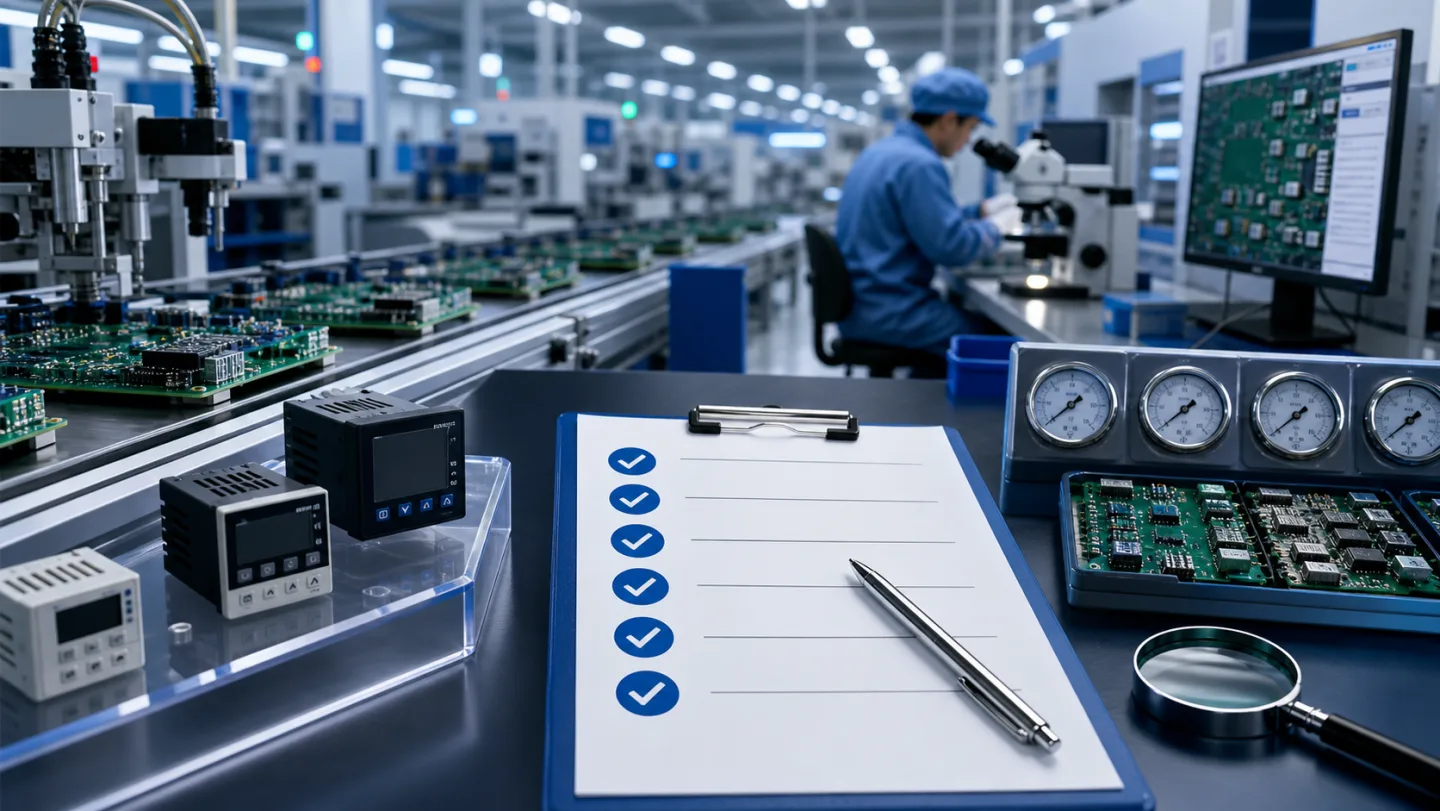
Once a buyer decides to move from a standard, off-the-shelf thermostat to an OEM or private-label controller, the hardest part usually is not deciding what to customize — it is picking the right supplier to build it. Two factories can quote the same spec sheet and deliver very different outcomes: one becomes a long-term engineering partner, the other turns every firmware change into a support ticket. This checklist covers what actually separates the two before you sign anything.
Start with manufacturing capability, not the sales pitch
The first question is not "can you build this," it is "who actually builds this." Many suppliers quoting OEM temperature controllers are trading companies that subcontract the real manufacturing, sometimes to more than one factory depending on order size. That is not automatically disqualifying, but it changes who controls your firmware source, your quality process, and your lead time when something goes wrong.
Ask directly: do you own the PCB design and firmware source code, or license it from a third party? A supplier that owns both can modify control logic on request. One that resells someone else's platform usually cannot go beyond relabeling and basic parameter changes.
Firmware and engineering support are the real differentiator
Anyone can put your logo on a standard controller. Far fewer can adapt the control algorithm, add a communication protocol, or change default parameters to match your application. Ask for concrete examples of past custom firmware work — a different defrost strategy, a custom Modbus register map, an added alarm condition — not just a list of features the base product already supports.
It is also worth asking whether firmware engineering is in-house or outsourced. In-house engineers mean faster iteration and a single point of accountability. Outsourced firmware often means longer turnaround and a supplier who has to relay your requirements to someone else.
Quality systems and certification
For any OEM programme destined for a regulated market, certification is not optional. Confirm:
- ISO 9001 or equivalent quality management certification
- CE / RoHS for the EU, UL for North America, or the relevant marks for your target market
- Component traceability — can a batch of controllers be traced back to specific component lots if a field issue appears
- Incoming inspection and burn-in testing on finished units, not just final visual QC
Ask to see the actual QC documentation and test reports for a comparable product, not just a claim that "we follow ISO 9001." A supplier confident in their process will show you the paperwork without hesitation.
The sample and prototype process tells you how they will treat you post-order
Before committing to volume, every serious OEM engagement goes through a sample or prototype stage. How a supplier handles this stage is the clearest preview of how they will handle you after the purchase order is signed. Ask:
- How long does a modified engineering sample take, from confirmed spec to sample in hand?
- Are engineering samples charged, and how many iterations are included before extra charges apply?
- Will the sample be validated against your actual load and environment, or only bench-tested at the factory?
A supplier that pushes back on reasonable sample requests, or treats every revision as a new negotiation, will behave the same way once you are dependent on them for production.
Documentation transparency
Ask to see a sample Modbus register map, wiring diagram, or parameter list for an existing product before you commit. A supplier willing to share real documentation upfront is signaling that your engineering team will get equally clear documentation for your custom build. Vague answers here — "we'll provide that after the order" — are a warning sign, not a formality.
Minimum order quantity and flexibility
MOQ varies enormously depending on how deep the customization goes — a firmware-only rebrand and a fully custom enclosure sit at completely different MOQ tiers. We cover the specific numbers, tooling costs, and how to keep MOQ low while you validate a new OEM line in a follow-up article on MOQ, tooling cost, and lead time.
IP protection and exclusivity
If your customization involves a genuinely differentiated control strategy or register map, ask how the supplier handles confidentiality. A written NDA covering your specification and firmware is standard practice, not a special request. If exclusivity in your market or product category matters to you, put it in writing before volume commitments, not after.
A quick supplier evaluation checklist
- Do they own the hardware design and firmware source, or resell someone else's platform?
- Can they show real examples of custom firmware work, not just base-product features?
- Is engineering in-house, and who is your point of contact for technical questions?
- What certifications do they hold for your target market, and can they produce the documentation?
- How long does an engineering sample take, and what does revision cost?
- Will they share register maps and wiring documentation before you commit?
- What MOQ applies to your customization tier, and does it scale down if you start small?
- Is an NDA and, if needed, an exclusivity clause standard practice for them?
If a supplier answers all eight without hedging, you are likely looking at a real manufacturing partner rather than a reseller. Beamform manufactures its own controllers in Jiangsu, China, and handles firmware, hardware, and enclosure customization in-house. To talk through what a supplier evaluation should look like for your specific project, contact the Beamform team, or read more about what is actually configurable in a custom OEM build.