
Compressor Current Monitoring for Refrigeration Systems
Learn how refrigeration compressor current monitoring reveals faults, improves alarms, and supports cold-room troubleshooting without replacing safety protection.
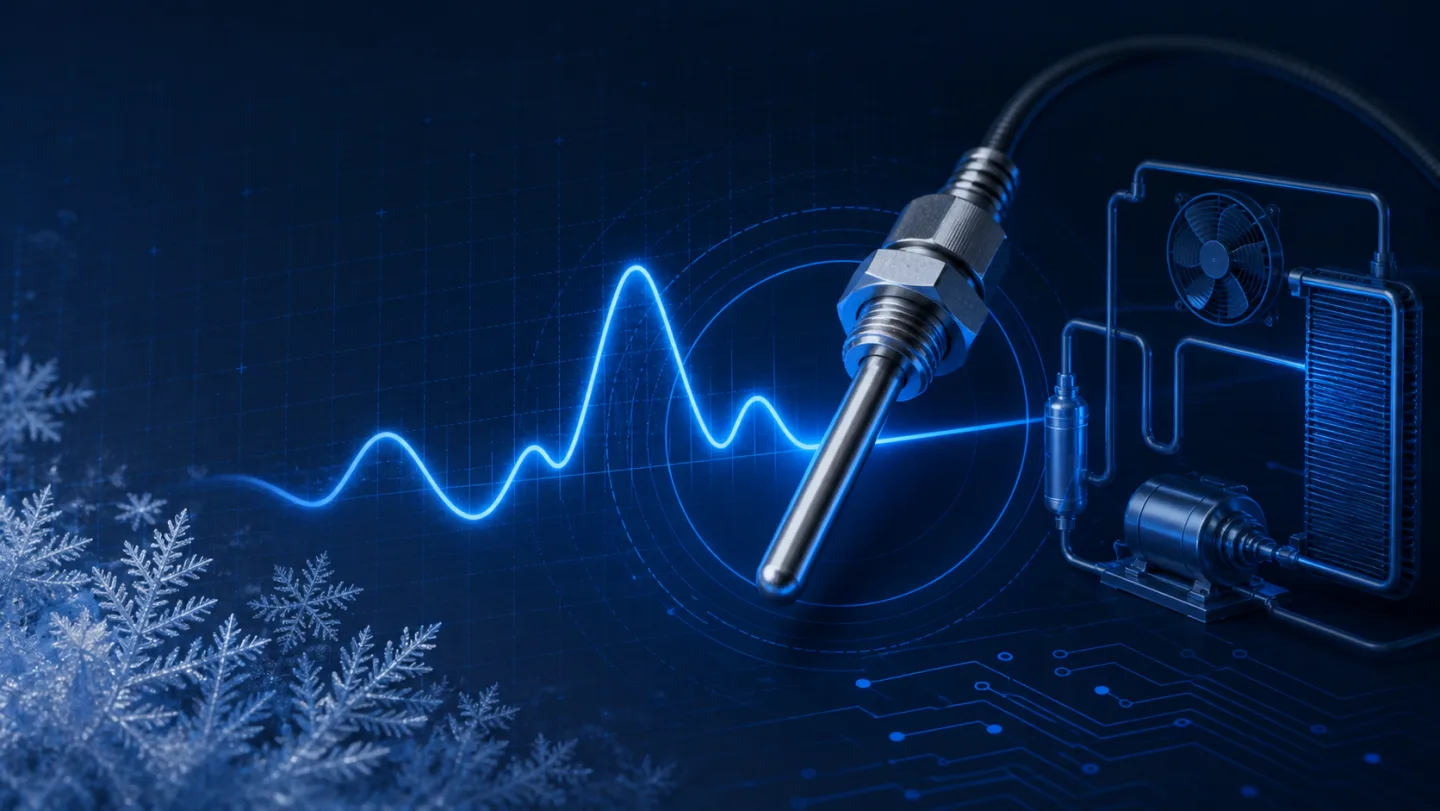
A cold room can still show the right temperature while its compressor is beginning to struggle. The thermostat only sees the result inside the room; compressor current adds a second view of what the refrigeration system is doing to achieve that result.
Current monitoring does not diagnose every fault, and it does not replace a circuit breaker, motor overload, pressure switch, or the compressor manufacturer's protection requirements. Used correctly, however, it can reveal abnormal operating patterns earlier and give a technician a much better place to start.
If you are still defining the controller architecture, begin with our cold storage thermostat selection guide. Current feedback becomes even more useful when it is combined with the temperature and alarm history described in our remote cold-room monitoring guide.
Why measure compressor current at the controller?
The electrical current drawn by a compressor changes with its operating condition. Start-up produces a short, high-current event. Once running, the current should settle into a range that reflects the compressor, supply voltage, refrigerant circuit, ambient conditions, and cooling load.
A controller that can read current can use that signal in three practical ways:
- Confirm operation: a cooling command is present and measurable current confirms that the compressor circuit is actually running.
- Raise an alarm: current above or below a configured range can flag an abnormal condition for inspection.
- Build context: current, room temperature, alarm state, and run time together are more informative than any one value by itself.
The real benefit is not a single amp reading. It is the relationship between current and the rest of the system over time.
What high current may indicate
Sustained current above the normal operating band means the motor is working harder than expected, but it does not identify one cause on its own. Possible causes include difficult pressure conditions, restricted condenser airflow, supply-voltage problems, a mechanical issue, or an electrical fault.
The operating moment matters. A brief inrush during start-up is normal, so an alarm that reacts instantly may produce nuisance trips. High current immediately after defrost or a long standstill may also have a different cause from high current during stable operation.
For that reason, a useful high-current alarm normally needs both a threshold and a delay. The threshold should be based on the compressor and system documentation, while the delay should ignore normal starting behavior without masking a genuine overload. Never copy a current limit from another cold room simply because the compressor capacity looks similar.
What low or zero current may indicate
Low current is often overlooked because it sounds safer than high current. In practice, unexpectedly low current can be just as useful diagnostically.
If the controller calls for cooling but measures no current, the compressor may not have started. The cause could be upstream power loss, an open protection device, a contactor problem, disconnected sensing hardware, or another control interlock. If current is present but lower than the system's established baseline, the refrigeration circuit may be operating under an unusual load or the measurement setup may need checking.
The key comparison is command versus response:
- Did the controller request compressor operation?
- Did current appear after the contactor was energized?
- Did the current settle within the expected running band?
- Did room temperature respond at a reasonable rate?
That sequence turns a vague “room not cooling” alarm into a much narrower troubleshooting path.
Current trend matters more than one snapshot
The same compressor can draw different current on a hot afternoon, just after loading warm product, and near the end of a pull-down cycle. A single reading without context is therefore easy to misinterpret.
A better approach is to establish a baseline during known-good operation. Record current alongside room temperature, ambient conditions, compressor state, and the stage of the refrigeration cycle. Then watch for repeatable changes:
- running current gradually rising under similar conditions;
- longer run time without a corresponding temperature improvement;
- repeated starts followed by protection trips;
- current behavior changing sharply after maintenance;
- abnormal current appearing only after defrost or during high-load periods.
These patterns do not replace gauges and electrical tests, but they help decide where a qualified technician should look first.
How to set alarms that operators will trust
An alarm that fires during every normal start will soon be ignored. Alarm settings should reflect the equipment rather than use one universal number.
Start with the compressor nameplate, manufacturer instructions, system design, and measurements taken during stable operation. Then define:
- a high-current threshold appropriate to the compressor and its protection scheme;
- a low-current or no-current threshold that distinguishes a stopped compressor from normal running;
- a start-up delay long enough to ride through expected inrush;
- an alarm persistence time so a momentary fluctuation does not create noise;
- a reset policy that prevents repeated automatic restarts where manual inspection is required.
Alarm history should include time, measured current, temperature, compressor command, and recent defrost status. Those details are far more useful to service personnel than a generic overload message.
Current monitoring is an extra layer—not the safety system
It is important to draw a firm boundary around what a refrigeration controller can do. Current sensing is useful for supervision, alarms, and control logic, but it must not be treated as a substitute for correctly selected electrical and compressor protection.
The installation may still require suitable fuses or circuit breakers, motor overload protection, pressure controls, phase or voltage protection, contactors, and any protection specified by the compressor manufacturer or local electrical rules. Protective settings must be selected and commissioned by qualified personnel.
Think of controller-based current monitoring as an early-warning and diagnostic layer. It helps the system explain what happened; the dedicated safety devices remain responsible for safely interrupting fault conditions.
A commissioning checklist
Before enabling current alarms on a new refrigeration controller, verify the following:
- The current sensor is installed in the correct conductor and orientation.
- The displayed value is checked against a suitable calibrated instrument.
- Start-up inrush is not being mistaken for running current.
- Normal running current is recorded under several representative loads.
- High, low, delay, and reset settings follow the equipment documentation.
- Alarm behavior is tested without defeating required safety protection.
- Operators know which alarms require a technician rather than repeated resets.
When standard hardware does not fit the refrigeration panel
Current monitoring is often part of a wider OEM controller requirement rather than a stand-alone feature. Beamform can start from a proven controller platform and customize the hardware to suit the customer's electrical and mechanical design. Depending on the project, that can include:
- changing the current-detection range or sensing arrangement;
- adjusting relay ratings and the number of output channels;
- adding or changing temperature, humidity, door-switch, and other sensor inputs;
- adapting PCB layout, panel dimensions, connectors, and enclosure format;
- designing for AC 110 V, AC 220 V, DC 24 V, or another agreed power architecture;
- integrating the required display, communication interface, and branded labeling.
Hardware customization must begin with the actual compressor, contactor, load, supply, sensor, panel, and certification requirements. The goal is not to add every available feature—it is to build a controller whose I/O, protection coordination, mounting, and service workflow match the equipment it will become part of. See our guide to custom OEM temperature-controller hardware and firmware for a fuller overview of the development process.
Choosing a controller with current detection
For refrigeration panels where current feedback would improve fault visibility, the current-detection variant of the BF-6801 / 6811 compact thermostat measures from 1–100 A while also managing temperature, defrost, fans, and an auxiliary output. For larger installations that benefit from an on-device help interface and a larger display, the BF-6812LC combines 1–100 A current detection with complete refrigeration control.
The right choice still depends on the compressor, switching arrangement, panel design, and protection requirements. Browse the full controller range or contact Beamform with your electrical diagram, I/O list, panel dimensions, and estimated order quantity to discuss a standard or custom hardware solution.
Frequently asked questions about compressor current monitoring
Can compressor current monitoring identify the exact fault?
Not by itself. High, low, or missing current narrows the investigation, but a technician still needs to compare the reading with temperature, pressures, voltage, operating state, and the compressor manufacturer's data.
Should the alarm limit equal the compressor nameplate current?
Not automatically. Nameplate information is an essential reference, but the correct monitoring threshold and delay depend on the compressor, starting method, system design, and dedicated protection already installed. Follow the equipment documentation and use a qualified technician.
Does a current-sensing controller replace a motor overload protector?
No. Controller-based current sensing is an additional monitoring and diagnostic layer. It does not replace the electrical, pressure, motor, or compressor protection required by the manufacturer and applicable rules.