
Defrost Termination Temperature: How It Works with a Time Limit
Learn how defrost termination temperature and maximum defrost time work together, where to place the evaporator probe, and how to commission the sequence.
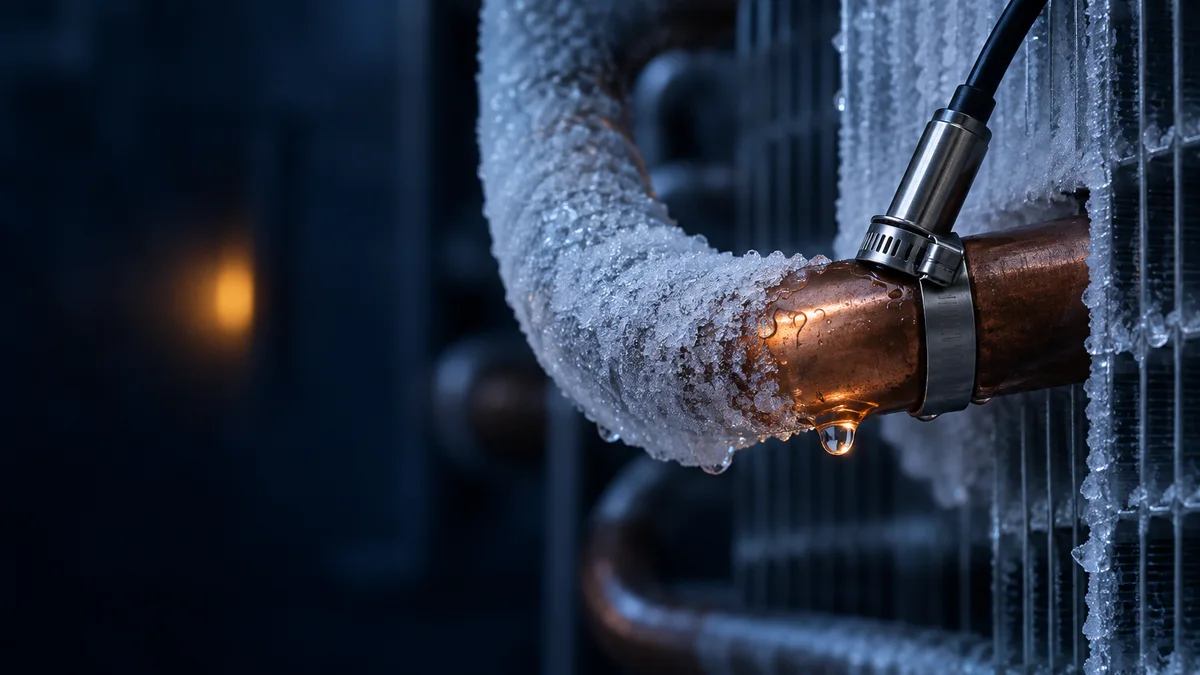
Defrost termination temperature is the evaporator-probe reading at which a refrigeration controller ends an active defrost cycle. It answers a practical question: has the coil warmed enough for the frost to be cleared? A separate maximum defrost time answers a different question: how long is the system allowed to keep trying if that temperature is never reached?
Using both conditions gives the sequence a normal stopping point and a backup limit. The result depends on more than two parameter values, however. Probe position, thermal contact, defrost method, fan delay, drainage, and the controller's event logic all affect what operators see after each cycle.
This guide focuses on the control sequence. For the differences between off-cycle, electric, and hot-gas systems, first see our comparison of refrigeration defrost methods. For room-control and monitoring probes, use the separate cold-storage sensor placement guide.
What can end a defrost cycle?
A refrigeration controller may end defrost in several ways, depending on the equipment design:
- Evaporator temperature: the defrost probe reaches the configured termination temperature.
- Maximum time: the cycle reaches its allowed duration before the probe reaches temperature.
- External input or equipment command: another control device reports completion or stops the sequence.
- Alarm or safety condition: a higher-priority condition interrupts normal operation.
- Manual stop: an authorized technician ends a service test through the intended control interface.
These endings do not mean the same thing. Temperature termination is normally evidence that the selected measuring point has warmed to the target condition. Time termination means only that the allowed time expired. A useful controller should make the reason visible in its event history, HMI, or communication data instead of reporting every result simply as “defrost complete.”
Why temperature and maximum time should work together
Temperature termination prevents a defrost cycle from continuing simply because a fixed timer is still counting after the coil has cleared. That can reduce unnecessary heat input and shorten the period before refrigeration returns to normal.
Maximum time is the fallback. The probe might be loose, insulated by ice, installed at an unrepresentative point, damaged, or unable to reach the target because the defrost system is not delivering enough heat. Without a time boundary, a fault in the measurement or process could keep the normal sequence active longer than intended.
The controller therefore evaluates two different truths:
- Has the evaporator reached the defined temperature condition?
- Has the cycle reached the longest permitted duration?
Whichever approved condition occurs first can end defrost. The maximum time is not proof that the coil is clear, and a temperature reading is only meaningful when the probe is correctly installed and verified.
Put the defrost probe where it represents the slow section
The room sensor and the defrost sensor have different jobs. A room sensor represents the controlled space or product environment. A defrost probe follows the evaporator so the controller can decide when the coil has warmed sufficiently.
The equipment or evaporator manufacturer's instructions should define the preferred measuring point. In many designs, the probe is secured to a return bend or another location selected to represent a slow-to-clear part of the coil. It should have firm thermal contact, suitable moisture protection, and cable routing that keeps the signal away from power wiring and physical damage.
Avoid choosing a position only because it is easy to reach. A probe too close to a heater, hot-gas entry, warm air path, or quickly clearing coil edge may terminate defrost before the more heavily frosted area is ready. A probe buried in an unusually cold or poorly heated pocket may force cycles to run to the time limit even when most of the coil is already clear.
After service, confirm that the probe has not moved and that insulation, clamps, cable ties, or replacement parts have not changed its thermal response.
How to choose a defrost termination temperature
There is no universal termination temperature that should be copied across all evaporators. Start with the evaporator, refrigeration-system, defrost-component, and controller documentation. The correct target depends on factors such as:
- whether the system uses off-cycle, electric, or hot-gas defrost;
- evaporator construction and the selected probe location;
- freezer or cooler operating conditions;
- the amount and distribution of frost under representative loads;
- required drainage and drip-off behavior;
- product-temperature limits and the acceptable recovery pattern.
Then verify the setting on the actual equipment. If termination occurs while frost remains in repeatable areas, check the probe location, attachment, sensor accuracy, and heat distribution before simply raising the target. If the coil clears early but heating continues, determine whether the probe is slow to respond or placed in a section that does not represent the intended endpoint.
A parameter change should follow a diagnosis. Raising the temperature to compensate for a loose probe can add heat without solving the measurement fault; lowering it to shorten a cycle can leave ice that grows over subsequent cycles.
How to choose the maximum defrost time
The maximum time should be long enough for a normal, demanding defrost to reach temperature, but it should still act as a meaningful boundary when something is wrong. Base it on equipment documentation and observations from commissioned cycles under realistic frosting conditions.
Do not treat a time-limit ending as an equivalent success. If normal cycles repeatedly end on time rather than temperature, investigate:
- whether the probe reading is plausible and changes smoothly;
- whether the probe is firmly attached at the correct point;
- whether heaters, valves, relays, contactors, or refrigerant flow operate as designed;
- whether frost loading, door traffic, infiltration, or airflow has changed;
- whether drainage or ice accumulation is affecting the evaporator;
- whether the configured units and parameter meanings match the controller documentation.
The event log should preserve which condition ended each cycle. A rising share of time-limited cycles can provide an early service clue even before the room develops an obvious temperature alarm.
Coordinate termination with drip-off, fans, and compressor restart
Defrost termination is not the end of the whole recovery sequence. After heating stops, the controller may need to hold outputs in defined states while meltwater drains and the coil cools.
A complete sequence should specify:
- what happens to the compressor and fans when defrost begins;
- which output supplies the heater or controls the defrost valve;
- which condition ends active defrost;
- how long drip-off lasts and what remains off during it;
- when refrigeration can restart;
- whether the evaporator fan waits for a coil-temperature condition, a delay, or both;
- how alarms and manual commands interact with every stage.
Starting the fan while the coil is still warm can move heat and moisture back into the room. Restarting the compressor without coordinating protection timers can also produce confusing states. The compressor anti-short-cycle delay guide explains how minimum off-time differs from defrost and drip-off timing.
Commission the sequence, not just the parameters
Observe several complete cycles under conditions that represent actual operation. Work should be performed by qualified refrigeration or electrical personnel without bypassing required protection.
Use a commissioning record that captures:
- defrost start reason and start time;
- room and evaporator temperatures before defrost;
- probe attachment and a comparison with a suitable reference instrument;
- heater, valve, compressor, and fan output states;
- evaporator-temperature trend during the cycle;
- termination reason, temperature, and elapsed time;
- drip-off and fan-restart behavior;
- visible frost, drainage, and room-temperature recovery after the cycle.
Test a normal temperature termination and the designed response to a probe fault or time limit using the approved service procedure. Confirm that the display, alarm output, remote monitoring, and event log distinguish the states clearly. Do not create a sensor fault by unsafe live-panel work or defeat protection devices for the sake of a test.
Specify defrost logic clearly for an OEM controller
For an OEM refrigeration controller, “time and temperature defrost” is only the beginning of a specification. Define the sensor type and location, the exact comparison logic, when the maximum-time clock starts, which condition has priority, and what happens after each termination reason.
Also define the operator experience: which parameters are installer-only, what the display shows during defrost and drip-off, whether the termination reason is logged, which states are available over the communication protocol, and how sensor faults are reported. Hardware inputs and outputs, firmware sequencing, HMI pages, communications, and branded labeling should all describe the same workflow.
Beamform's BF-6800 / 6810 series supports periodic defrost with time-or-temperature termination, drip-off delay, and fan management. The split-type touchscreen BF-6950 also combines dual-condition defrost termination with refrigeration, fan, alarm, and current-monitoring functions. The right controller and settings still depend on the evaporator, defrost method, switching hardware, sensor layout, and required protection.
Contact Beamform with your operating sequence, evaporator and defrost documentation, I/O list, display requirements, communication protocol, panel format, and branding brief to discuss a standard platform or customized hardware and firmware solution.
Frequently asked questions
What is defrost termination temperature?
It is the evaporator-probe temperature at which the controller ends active defrost and moves to the next defined stage, such as drip-off or refrigeration recovery.
Should defrost end by temperature or time?
Temperature is a useful normal termination condition, while maximum time provides a backup boundary. The sequence should record which one occurred rather than treating both as identical results.
Why does defrost always reach the time limit?
Possible causes include poor probe contact or position, a sensor or wiring problem, insufficient defrost heat, abnormal frost loading, restricted airflow, or an unsuitable target. Check the actual system and its documentation before changing settings.
Can the room-temperature sensor terminate defrost?
The room sensor and evaporator defrost probe normally serve different purposes. Use the sensor arrangement specified by the equipment and controller design; do not substitute one measurement for another without an engineered and tested sequence.