
Refrigeration Compressor Anti-Short-Cycle Delay: How to Set and Test It
Learn how a refrigeration compressor anti-short-cycle delay works, how it interacts with thermostat settings, and how to commission it without hiding system faults.
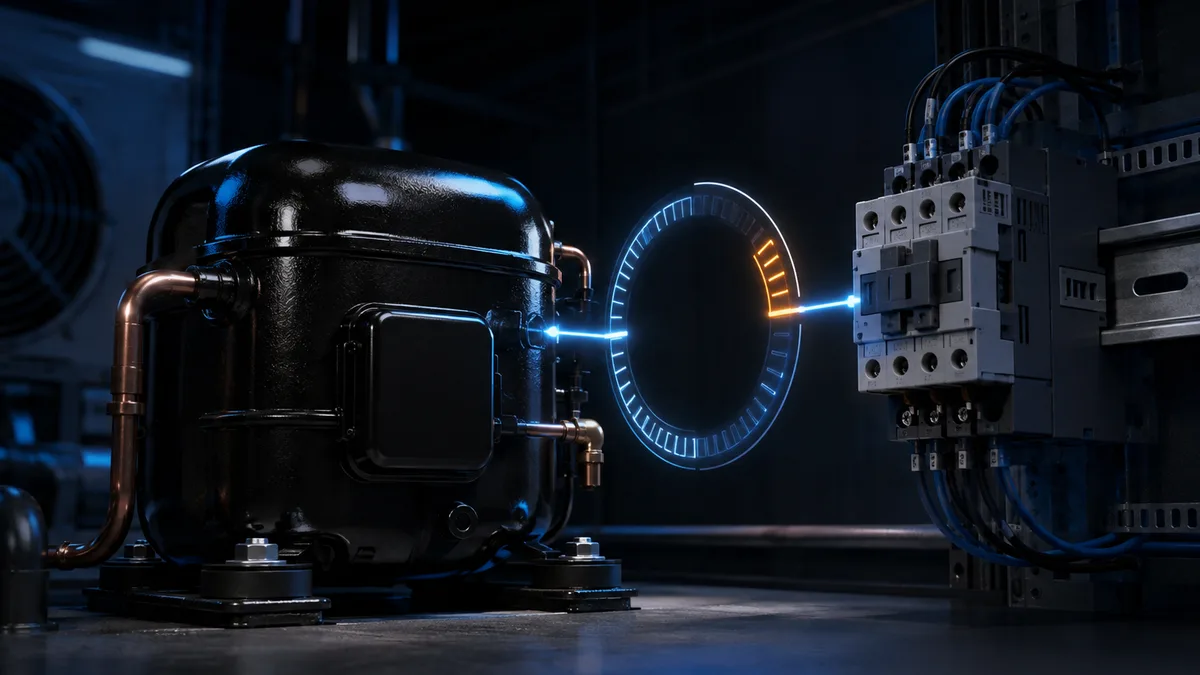
A refrigeration compressor anti-short-cycle delay is a simple control rule with an important job: after the compressor stops, the controller blocks another start until a defined minimum off-time has passed. This pause reduces repeated start attempts when temperature, pressure, power, or control signals are unstable.
The delay is useful, but it is not a cure for a short-cycling system. A controller can prevent an immediate restart while a poor sensor location, narrow temperature differential, oversized system, unstable input, or refrigeration fault continues to create demand. This guide explains how to specify, set, and test the delay as one layer of a complete control strategy.
If you are still choosing the overall control architecture, start with our cold-storage thermostat selection guide. For a second diagnostic signal beyond temperature, see our guide to compressor current monitoring.
What anti-short-cycle delay actually controls
The controller normally evaluates two separate questions:
- Does the temperature logic call for cooling?
- Is the compressor currently allowed to start?
If cooling is required but the minimum off-time has not expired, the demand remains pending while the compressor output stays off. When the delay ends, the controller can energize the output if the demand and all other permissive conditions are still valid.
This distinction matters on the display and in remote monitoring. “Cooling requested” and “compressor running” are not always the same state. A clear interface should show whether the output is off because the setpoint is satisfied, a restart delay is active, a defrost sequence is running, or an alarm or protection condition is present.
Why rapid restarting is a problem
Starting is a demanding operating moment for a compressor and its switching equipment. Repeated starts can add electrical and mechanical stress, heat contactors and motor windings, and produce unstable refrigeration performance. A system that starts and stops frequently may also struggle to hold a useful temperature pattern even when its average room temperature looks acceptable.
Anti-short-cycle logic limits how quickly the controller can command another start. Dedicated electrical, motor, pressure, and compressor protection still remain necessary where required by the equipment manufacturer and applicable rules. The thermostat delay must not be treated as a replacement for those devices.
Minimum off-time is different from other delays
Several controller timers may affect the compressor, and their names are easy to confuse:
- Power-up delay prevents multiple units from starting together after power returns and gives the control system time to stabilize.
- Minimum off-time starts when the compressor output turns off and blocks a restart until the timer expires.
- Minimum run-time keeps an operating compressor on for an agreed period unless a higher-priority safety condition requires it to stop.
- Alarm delay waits before reporting a temperature or input condition so that brief, expected events do not create nuisance alarms.
- Defrost and drip-off timing coordinates the compressor, heaters or valves, and evaporator fans during and after defrost.
These timers solve different problems. One value should not silently stand in for all of them. The controller sequence, commissioning sheet, and operator interface should use consistent names so technicians can tell which state is active.
How to choose an appropriate setting
There is no universal anti-short-cycle delay for every compressor or cold room. Use the compressor and refrigeration-system documentation, the starting method, the controller manual, and the equipment designer's requirements as the primary references.
Then consider the complete operating pattern:
- how quickly the measured temperature moves around the setpoint;
- the thermostat differential and sensor response;
- normal loading, door opening, and defrost recovery;
- whether multiple compressors or stages are sequenced;
- how the system should recover after a power interruption;
- any manufacturer-required lockout or reset behavior.
A delay that is too short may not meaningfully limit repeated starts. A delay that is unnecessarily long can allow temperature to drift while valid cooling demand waits. The correct setting balances equipment requirements with the room's thermal behavior; it should be documented rather than copied from an unrelated installation.
Fix the cause of short cycling, not only the symptom
If the delay activates repeatedly during steady operation, treat that as a diagnostic clue. Common areas to investigate include:
- a temperature differential that is too narrow for the application;
- a sensor influenced by supply air, a door, a heater, or another local disturbance;
- loose terminals, control-power interruptions, or a bouncing input;
- an oversized refrigeration system with very short pull-down periods;
- unstable capacity control or staging logic;
- a protection device opening and resetting;
- airflow, refrigerant-circuit, or mechanical problems that require a qualified technician.
Changing the delay can reduce the visible start frequency without correcting any of these causes. Review temperature history, compressor command, measured current where available, alarms, defrost state, and door events together. Our temperature-sensor placement guide explains how a misleading measurement point can destabilize otherwise reasonable control logic.
Coordinate the delay with setpoint and differential
The temperature differential determines when cooling demand switches on and off around the setpoint. If the differential is narrower than the real noise and fluctuation at the sensor, demand can change too often. The anti-short-cycle timer then spends much of its time blocking requests created by the measurement rather than by a meaningful change in room load.
Commission the sensor position, calibration check, setpoint, differential, and delay as one system. Observe several complete cooling cycles under representative conditions. Confirm that the compressor reaches a stable run, remains off for the intended interval, and returns the room toward setpoint without excessive overshoot or repeated pending starts.
Commissioning test for an anti-short-cycle delay
Use a controlled test procedure that does not bypass required safety protection:
- Confirm the configured timer name, value, units, and when it starts counting.
- Run the system until the compressor is operating normally, then create a normal stop through the approved control method.
- Reintroduce cooling demand before the minimum off-time has expired.
- Verify that the controller indicates pending demand or delay while the compressor output remains off.
- Confirm that the compressor can start only after the timer expires and all other permissive conditions remain valid.
- Test power restoration, defrost termination, alarm recovery, and manual commands according to the designed sequence.
- Record the result in the commissioning sheet and explain the displayed delay state to operators.
Do not test by rapidly disconnecting power, forcing contactors, or defeating pressure, overload, or motor protection. A qualified refrigeration or electrical technician should perform work inside the panel and verify the actual switching circuit.
Specify the behavior clearly for an OEM controller
For OEM and private-label projects, “add compressor delay” is not a complete requirement. Define the sequence in operational terms:
- which events start or reset the timer;
- whether power-up and minimum off-time are separate;
- what the display shows while a start is blocked;
- whether the remaining state is available over the communication protocol;
- how manual mode, defrost, alarms, and sensor faults interact with the delay;
- which settings are installer-only and which operators may change;
- what should be written to the event or alarm history.
Beamform can discuss hardware inputs and outputs, firmware sequences, display and HMI behavior, communication protocols, and branded/OEM interfaces around an agreed refrigeration workflow. This turns a timer into a testable control requirement rather than an ambiguous parameter name.
The BF-6800 / 6810 series and BF-6812LC include compressor start-up delay protection as part of their refrigeration-control functions. The appropriate controller and settings still depend on the compressor, contactor, system sequence, panel design, and protection requirements. Contact Beamform with your electrical diagram, I/O list, compressor documentation, operating sequence, and target application to discuss a standard or customized solution.
Frequently asked questions
What is a compressor anti-short-cycle delay?
It is a controller timer that blocks the compressor from restarting until a minimum off-time has passed after a stop, even if cooling demand returns earlier.
What should I set the compressor restart delay to?
Use the compressor and refrigeration-system documentation, controller instructions, starting method, and equipment designer's requirements. There is no single value that is correct for every installation.
Why is the compressor delay always active?
Repeated delay events usually mean cooling demand is returning too quickly or the control signal is unstable. Check the differential, sensor position, wiring, power, defrost sequence, staging logic, and refrigeration system instead of only extending the timer.
Does anti-short-cycle delay replace compressor protection?
No. It is a control function that limits restart commands. It does not replace required overload, pressure, phase, voltage, motor, circuit, or manufacturer-specified protection.