
Evaporator Fan Delay After Defrost: How to Set and Test It
Learn how evaporator fan delay after defrost works, how drip time and coil temperature interact, and how to commission the sequence without blowing warm, wet air.
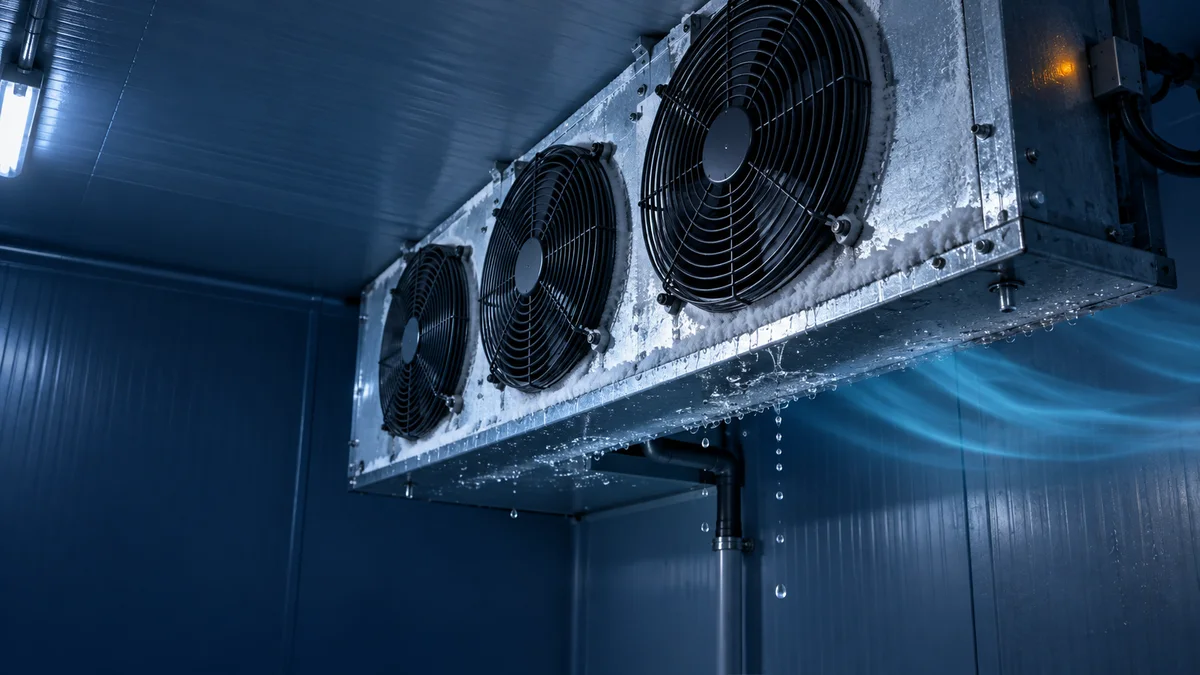
Evaporator fan delay after defrost is the controlled pause between restarting refrigeration and circulating air through the cold room. During that pause, meltwater can finish draining and the evaporator can cool before its fans move air across the coil again.
The idea is simple, but the parameter is often confused with drip-off time, compressor delay, or the temperature that terminates defrost. Those settings belong to different stages. This guide explains the sequence, how time- and temperature-based fan restart logic differ, and how to commission the result without copying a value from an unrelated installation.
For the wider defrost decision, first read our comparison of electric, hot-gas, and off-cycle defrost. If the room-control probe itself is producing misleading readings, use our cold-storage temperature sensor placement guide.
Where fan delay fits in the defrost recovery sequence
Defrost recovery is not one event. A typical controller may move through several distinct states:
- Defrost ends because the evaporator sensor reaches its termination temperature or the maximum defrost time expires.
- Drip-off time keeps refrigeration or other outputs in their designed state while meltwater leaves the coil and drain tray.
- Refrigeration resumes so the evaporator begins cooling again.
- The evaporator fan remains off until a time limit, a coil-temperature condition, or an agreed combination permits it to start.
- Normal control resumes, including the intended compressor, fan, alarm, and door logic.
Controller terminology is not universal. For example, the official Danfoss ERC 21X user guide separates drip-off time, fan delay after defrost, and fan start temperature. Its fan delay is measured from compressor start after defrost. Another controller may start its timer at defrost termination or after drip-off. Always confirm the state diagram and timer origin in the actual controller manual.
Why the fan should not always start immediately
An evaporator can be warm and wet when defrost finishes. Starting the fan at that moment may circulate residual heat and moisture into the refrigerated space instead of first allowing the coil to return toward normal operation.
The delay can support three practical objectives:
- Keep residual defrost heat near the evaporator while refrigeration cools the coil again.
- Reduce water carryover by giving droplets time to drain or refreeze on the coil rather than being blown into the room.
- Create a repeatable recovery sequence that operators and monitoring systems can distinguish from a normal cooling cycle.
Fan delay is not a repair for a blocked drain, failed drain heater, damaged fan, iced coil, or incorrect defrost termination. If water continues to leave the evaporator casing or recovery takes longer than expected, inspect the mechanical and refrigeration system instead of indefinitely extending a timer.
Drip-off time, fan delay, and fan start temperature are different
These three parameters are often grouped in one menu, but they answer different questions.
Drip-off time asks: how long should the system allow liquid water to leave the evaporator after defrost? Depending on the controller and refrigeration design, compressor or valve operation may remain off during this stage.
Fan delay after defrost asks: after refrigeration begins recovering the evaporator, how long may the fan remain stopped before it is released or forced to start?
Fan start temperature asks: is the evaporator cold enough to circulate air again? This normally requires a correctly installed evaporator or defrost sensor.
Do not assume that one timer performs all three jobs. Write the required sequence in plain language, then map each state to the controller parameters. The Danfoss AK-RC 251 guide, for example, describes fan start-up delay as a way to let remaining droplets bind to the evaporator and avoid adding defrost heat to the room.
Time-based, temperature-based, and combined restart logic
A time-only strategy starts the fan after a configured interval. It is simple and can work where the equipment, load, and recovery pattern are consistent. Its weakness is that a fixed time does not prove the coil is cold. Recovery can change with room load, ambient conditions, defrost duration, refrigerant-system performance, or a service fault.
A temperature-based strategy uses the evaporator sensor to release the fan after the coil reaches an agreed condition. This responds to the actual recovery state, but it depends on the sensor, its mounting location, calibration, wiring, and fault handling. A sensor on the wrong part of the coil can indicate readiness too early or delay the fan even when the useful airflow path is already cold.
Combined logic often uses a temperature condition with a maximum waiting time. The temperature condition provides the normal release; the maximum time prevents the fan from remaining off forever if the threshold is not reached. The controller should then expose enough status or alarm information to show that the fallback occurred. The exact priority between time and temperature differs by controller, so verify it rather than inferring it from a parameter name.
How to choose an appropriate fan-delay setting
There is no universal time or fan-start temperature for every cold room. Begin with the evaporator, refrigeration-system, controller, and equipment-manufacturer documentation. Then evaluate the installation as a complete system:
- defrost method and the amount of heat introduced;
- evaporator mass, fan arrangement, and drain design;
- room temperature and stored-product requirements;
- evaporator-sensor type, location, and response;
- expected pull-down and post-defrost recovery time;
- door opening, loading, and other airflow disturbances;
- what should happen if the sensor fails or the maximum delay expires.
A delay that is too short may release warm, moisture-laden air. A delay that is unnecessarily long reduces air circulation and can make room-temperature recovery slower or less even. The correct setting should be supported by an observed recovery test, not selected because it is the factory default or worked on a different evaporator.
Coordinate fan delay with compressor and alarm logic
Post-defrost fan delay must fit the rest of the controller sequence. The compressor may also have a minimum off-time, a power-up delay, or another permissive condition. Our guide to compressor anti-short-cycle delay explains why those timers should remain distinct.
Alarm behavior needs the same care. A high room temperature immediately after a planned defrost may be expected, so some systems use a separate post-defrost alarm delay. That delay must not hide an evaporator that failed to cool, a fan that never restarted, or a room that did not recover. Record the end of defrost, compressor command, fan command, evaporator temperature, room temperature, and fallback events where the monitoring architecture supports them.
Door logic can also override the fan output. If fans are designed to stop when a cold-room door opens, test the case where a door event overlaps the end of defrost. A clear controller should make the active reason visible instead of showing only a generic “fan off” state. See our cold-room door alarm guide for the wider door-event design.
Common fan-delay problems and what they suggest
The fan starts too early
Check whether the fan delay is enabled for the selected defrost type, where the timer starts, and whether a temperature threshold is overriding the timer. Confirm that the evaporator sensor has not been placed where it cools much faster than the rest of the coil. Also verify that a manual command, test mode, or output mapping is not bypassing the intended state.
The fan starts too late or never restarts
Confirm the live evaporator temperature and sensor status, then compare them with an independent check using an appropriate instrument and procedure. Investigate a loose or damaged probe, incorrect sensor selection, wrong scaling, poor mounting contact, insufficient refrigeration recovery, or a maximum delay that is disabled or misunderstood. Verify the relay, contactor, fan protection, and wiring separately from the controller command.
Water is blown from the evaporator
Do not assume that more fan delay is the complete answer. Inspect the drain tray, drain line, trap, heaters where fitted, coil cleanliness, evaporator level, defrost termination, and actual water path. Mechanical drainage faults require correction even if a longer delay temporarily reduces visible droplets.
The room recovers slowly after every defrost
Review the complete timeline: how defrost starts and ends, how much heat it adds, whether drip-off is excessive, when refrigeration resumes, when fans restart, and how room and coil temperatures respond. One overlong stage can look like a refrigeration-capacity problem when the real issue is control sequencing.
Commissioning checklist for post-defrost fan restart
Use a planned test under representative conditions and follow the equipment's service and safety procedures:
- Record the defrost method, termination condition, maximum duration, drip-off setting, fan-delay setting, fan-start temperature, and fallback behavior.
- Confirm the room and evaporator probes are identified correctly and display plausible values before starting.
- Observe a complete defrost without forcing contactors or bypassing protection devices.
- Record the exact times when defrost output stops, refrigeration restarts, fan output is permitted, and the fan actually runs.
- Confirm whether time or temperature released the fan and that the interface reports the active state correctly.
- Inspect drainage and watch for water carryover when airflow begins.
- Verify room-temperature recovery and airflow at representative locations.
- Test the documented sensor-fault and maximum-delay response using an approved method.
- Check any post-defrost alarm inhibit and confirm it expires as designed.
- Save the final settings and results in the commissioning record.
Work inside electrical panels and refrigeration equipment should be performed by qualified personnel. Do not defeat pressure, overload, fan, heater, or other required protection to make the test faster.
Specify the sequence clearly for an OEM controller
For an OEM or private-label project, “fan delay after defrost” is not a complete firmware requirement. Define:
- which event starts the timer;
- whether drip-off and fan delay are independent;
- which sensor releases the fan and what happens if it fails;
- whether time, temperature, or both control normal restart;
- the maximum wait and the event or alarm raised if it expires;
- how manual defrost, door input, compressor delay, and alarms interact;
- what operators see on the display or HMI;
- which states and settings are available through the communication protocol;
- which parameters installers may change and which are locked.
Beamform can discuss hardware inputs and outputs, embedded firmware sequencing, display and HMI behavior, communication protocols, and branded/OEM interfaces around an agreed refrigeration workflow. The BF-6800 / 6810 series and compact BF-6801 / 6811 series support evaporator-fan management, defrost control, drip-off, and post-defrost fan delay. Final settings and protection still need to match the actual evaporator and refrigeration system.
Contact Beamform with your sequence diagram, I/O list, probe details, defrost method, fan circuit, and target application to discuss a standard or customized controller.
Frequently asked questions
What is evaporator fan delay after defrost?
It is the period after defrost when refrigeration can begin cooling the evaporator while the fan remains off. The fan starts when the configured time, coil-temperature condition, or combined logic permits it.
Is fan delay the same as drip-off time?
No. Drip-off time allows meltwater to leave the evaporator after defrost. Fan delay normally controls how long the fan stays off while the evaporator cools after refrigeration resumes. Exact sequencing depends on the controller.
What should the fan delay after defrost be set to?
Use the evaporator, refrigeration-system, and controller documentation, then validate the setting by observing a complete recovery cycle. There is no single time or temperature suitable for every cold room.
Why does the evaporator fan not restart after defrost?
Possible causes include a coil that has not reached the fan-start threshold, an evaporator-sensor fault or placement problem, a misunderstood maximum delay, another active interlock, or a fault in the fan output, contactor, protection, or wiring. Check command and actual operation separately.